Short answer: The most reliable way to get new B2B clients is not cold outreach but building your own audience first: people from your exact target group sign up for genuinely useful content, you build trust through email, webinars and LinkedIn, and only then do you talk to them in person. In the short term, three levers work without an ad budget: call existing contacts, send an email featuring real client feedback and run a webinar. In the long term, a systematic seven-phase funnel fills your pipeline every day.
Are there proven strategies to win new clients fast? Ideally without a big ad budget? And without annoying people with cold calls and mass emails?
Yes, there are.
In this guide I've brought together everything we at XHAUER have written, tested and implemented with clients on this topic over the years: why classic cold outreach barely works in B2B anymore, which seven phases reliably fill a pipeline, which 5-message script gets leads on LinkedIn into a real conversation, and which levers you can pull right away, even with no ad budget at all.
The LinkedIn Pipeline Playbook: Want to do more than read about it and actually implement the process step by step? The playbook gives you the system behind this article in a compact, work-through format. Download The LinkedIn Pipeline Playbook for free (German)
Key terms explained
Client acquisition: Everything a company does to turn people who don't know it yet into paying clients. In B2B this usually takes longer than in consumer business because several people are involved in the decision and trust matters a lot.
Cold outreach: Contacting people who have had no prior contact with you and haven't asked to hear from you, by phone, email or LinkedIn message. Cold calling is the phone version.
Owned audience: Contacts from your exact target group who sit in your own contact list, CRM or email list. You can reach them without paying a platform every time.
Green bananas: My picture for leads who aren't ready to buy yet but are already part of your owned audience. They know you and your offer a little. Good content ripens them into "yellow bananas": prospects who want to talk to you.
Pipeline formula: My model for how good sales opportunities come about. Above the line: visibility × leads × trust. Below the line: dissonance + friction. The more the top grows and the bottom shrinks, the more good conversations land in your pipeline.
Shadow funnel (dark social): The invisible part of a buying decision: internal meetings, links forwarded in Teams chats, conversations with the boss. No tracking tool sees it, yet it often decides the deal.
MQL and SQL: A marketing-qualified lead (MQL) has shown interest, for example by downloading something. A sales-qualified lead (SQL) is ready for a sales conversation. Good marketing turns MQLs into SQLs as automatically as possible.
Permission marketing: You only take the next step in a conversation when the other person responds and so, in effect, gives you permission. If they pull back, you stop.
Performance content: Our term at XHAUER for content that isn't built for likes but contributes measurably to pipeline: ads, lead magnets, emails, posts and webinars that address the target group's exact problem.
Why cold outreach barely works in B2B anymore
Bad news for a lot of people in B2B marketing:
In our experience, cold outreach in B2B, whether by phone, by email or through LinkedIn Sales Navigator, barely works anymore.
Nobody wants mass emails or awkward cold calls they never asked for.
I talk to marketing leads from IT, software and consulting companies every day. Many have worked with providers who send cold emails in bulk to purchased address lists. Or who fire off Sales Navigator messages as if there were no tomorrow. Or who spend all day talking people's ears off on the phone, without knowing whether there's any need at all.
Sure, the law of large numbers means the odd meeting will come out of it. But what's the opportunity cost?
Danger 1: Damage to your brand
For every meeting you book, many more people in your target group come away with a bad impression of your company, your brand and your people. And that at a time when an owned audience and a positive brand are among a company's most valuable assets.
Is it really worth it?
Danger 2: Ice-cold leads in the conversation
I often hear:
"Michael, we do get a few meetings from our cold emails, but the people we end up talking to often have no idea who we are, what we do or how we can help them."
The result: those calls are guarded, exhausting, cost-inefficient and unpleasant for both sides.
Danger 3: Legal risk
I'm not a lawyer. But even I know it can't be right to buy email lists somewhere, upload them to your systems and then email or call everyone on them. If in doubt, have an expert check before you start cold emailing or calling. Rules on unsolicited contact differ between countries, and in Germany they are strict.
And let's be honest: it's also just embarrassing.
What works instead
I'm a big fan of email marketing and telesales. But only when you write to and talk with people from your exact target group who reached out to you first. Then you know they have a problem, a bottleneck, a pain point you can genuinely help with.
These leads also already know you a little. They've had several touchpoints with you and have been able to build trust, a relationship and demand. That's what the rest of this article is about.
The principle: your own audience instead of cold contacts
If I had to name one thing that makes the difference when winning new clients, it's this:
Build your own audience.
That has three big advantages:
- You're independent of the big ad platforms such as LinkedIn, Google, Facebook or TikTok.
- You've been collecting green bananas regularly from the start.
- You can fall back on this contact list whenever it's time to win new clients.
Through your own CRM you then run continuous nurturing with systematic content. New enquiries come in regularly without much extra effort, and marketing-qualified leads turn into sales-qualified leads as automatically as possible.
Marketing and sales often have a bit of a love-hate relationship. 😉 Yet with the right strategy, marketing can fill the pipeline with prospects from the exact target group quite simply. What matters is that it happens in a scalable, systematic way. In the end, sales should get opportunities that are like a penalty kick with no goalkeeper.
The pipeline formula as your compass
Behind everything that follows is a simple equation. I call it the pipeline formula:
Good sales opportunities = (visibility × leads × trust) ÷ (dissonance + friction)
Above the line are the three things you need to build: the right people have to see you, sign up with you and trust you. Because they multiply, one factor close to zero is enough to wreck the result.
Below the line is whatever slows you down. Dissonance happens when your message doesn't fit your audience, for example because you write in marketing speak instead of your clients' own language. Friction, as I define it, is "what's left when everything actually fits, but still nothing happens": the annoying form, the pushy approach, the missing phone number.
Each of the seven phases below feeds one of these factors. When nothing is happening, ask first: which factor is the bottleneck?
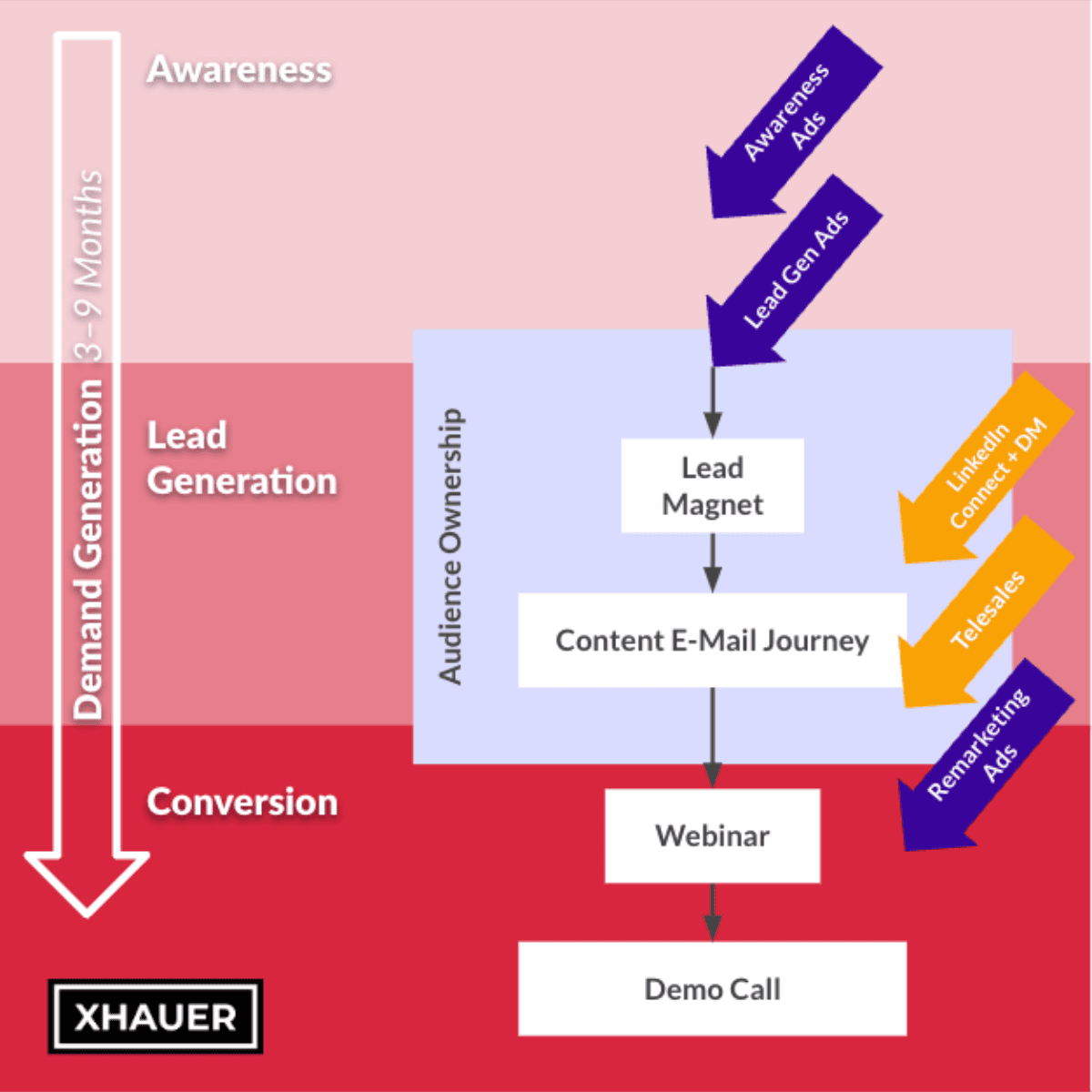
Getting new clients in 7 phases
The funnel we use for ourselves and our clients runs from first attention to the sales conversation. At XHAUER we almost always start on LinkedIn, because in B2B the platform is known for its precise targeting: you can reach specific job functions, seniority levels or companies in specific regions. We add other platforms later.
Phase 1: Understand your audience and create awareness
The foundation is a deep understanding of your target group. We assume we're addressing people who don't know us yet. We could help them perfectly, but they don't know that yet.
So we start at the top of the funnel with awareness ads and do two important things:
- We test the technical targeting: how do we reach exactly the people we can help best, at the lowest possible cost?
- We test the messaging, meaning the trigger symptom: what makes the right people recognise themselves? From that moment on, we have their attention.
The first thing people see when they scroll is the creative. Especially with a cold audience, it has to be a scroll-stopper. Three formats have worked well for us:
- Poster ads: a plain background and one short, punchy sentence. Ideally a typical belief readers recognise in themselves.
- Comic ads: a short, funny story from everyday working life that people identify with.
- Gamification: an image readers engage with first before they read the text.
The hook, the first lines of the ad, matters too. It should make people click "see more". If the text is gripping and psychologically smart, people read to the end. That keeps engagement high and, in our observation, makes the ads cheaper.
The rule in this phase: little branding, lots of trigger. Logos only subtly, brand mainly through colour. And always with the symptom readers know from their daily work.
Phase 2: Generate leads with a lead magnet
Once you know which trigger symptoms attract the right people, it's about building your owned audience. People from your exact target group should end up in your contact list, in your CRM. There they sit as green bananas. They won't knock on your door and buy the next day. But they're collected and can be nurtured. The B2B sales cycle is long, after all.
Bananas ripen at their own pace. You can't force them. As I like to put it: push a lead onto your offer too early and you don't make them riper, you bruise them. Your job is to create good ripening conditions.
The easiest way to build an owned audience is with PDFs, checklists, guides or playbooks. A lead magnet like this has to match the target group's problem that you measured in phase 1 exactly.
A few rules that have proven themselves for us:
- Call it a checklist or a guide, not a white paper or report. Those don't work well.
- Snackable, not walls of text: no 30 pages, but short sections following a how-to structure ("Step 1: do X …"). That way people really read to the end and get early wins.
- Real value: nobody happily hands over their details for a bland white paper. Deliver tools that help right away.
- Single image ad with a Lead Gen Form: in our tests this format was the most effective at driving downloads. The form opens directly inside LinkedIn, with no break caused by an external landing page.
- Don't ask for a phone number. That drives lead costs up sharply.
Our own playbook is an example, by the way: The LinkedIn Pipeline Playbook (German) is built exactly like this: short, step by step, ready to use.
Phase 3: Nurture with emails that genuinely help
What happens once someone has signed up? Nurturing and demand generation. You want to build trust, a relationship and demand. Leads should understand who you are and how you can help.
Step one is email marketing of very high professional quality:
- No pure sales emails. Think about the angle, the trigger symptom and the pain point people responded to in phase 1, and deliver content on exactly that.
- Cadence: send a little more often in the first two weeks after sign-up, then switch to weekly.
- Personal touch: write so people can put the tips into practice right away. Some won't even notice the email is automated and will reply.
This conditions your leads in a positive way: "When I get an email from them, it's good stuff. So I'll open the next one too." Everyone knows the opposite: if a newsletter adds no value, we tend not to open the next one.
For one of our clients, a series of eight such emails reached a 56% open rate and a 12% click rate across just under 2,000 emails sent.
My favourite trick: the 9-word email. About three weeks after sign-up, often as the seventh email in the series, you send an email of roughly nine words. No greeting, no sign-off, and the subject line is just "a question":
[Name], are you still interested in [topic]?
When we sent this to around 3,000 contacts, there were more than 90 hand-written replies in the inbox the next day. Not out-of-office notices, but genuine expressions of interest. The technique only works once per series, so use it deliberately.
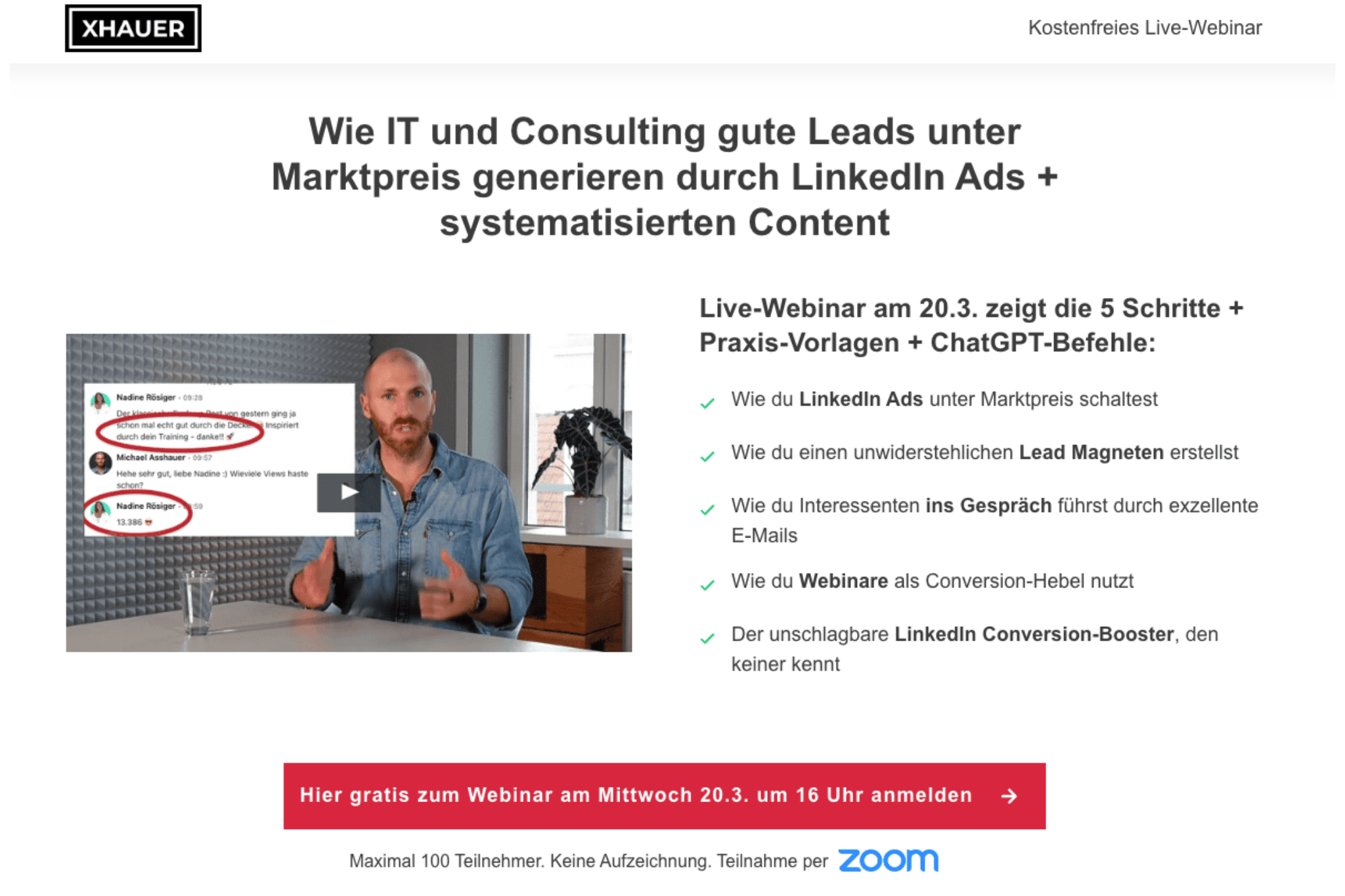
Phase 4: Webinars, the strongest building block
The strongest building block for turning green bananas into ripe ones at scale is webinars. To me, they are and remain the best way in B2B to build trust, relationship and demand with the exact target group.
Will the managing director of a mid-sized company really sit through a long webinar? In our experience: yes. Precisely when the title and content are highly relevant to them. Here, too, the results from phase 1 help.
What has worked for us:
- Live, not recorded. You can switch to automated evergreen webinars later. But we start with many live sessions, because people can tell when something isn't live, and because you learn something new every time.
- A clear five-step structure. When participants are told clearly what to expect and every step delivers real value, most stay to the end.
- A short pitch after step four. That's no problem as long as you've delivered real value first.
- Collect questions and answer them at the end. That keeps people in the webinar and makes for a good Q&A.
How to build a webinar is something I show in this video:
How to build a webinar (German)
Phase 5: Use retargeting
Retargeting comes in as an amplifier. On LinkedIn, ideally including the LinkedIn Audience Network so you're visible on other sites too. And through Google Ads.
This is where something interesting happens in B2B: you combine LinkedIn's precise targeting with Google's broad reach. On Google alone you normally can't get that kind of targeting. But if you only show ads there to people who came to you via LinkedIn first, you reach exactly the right audience across the whole display network.
You can use this to fill webinars, deliver more in-depth content or win calls and meetings directly.
Why this omnipresence matters so much is explained by the shadow funnel. Marketing works like an iceberg: most of the effect happens below the surface. A typical journey: ad, CEO's post, retargeting video, internal meeting, brand search, a link in a Teams chat, the boss, procurement, and only then the contact form. In my estimation, this invisible part can account for around 80% of your campaign results.
My tip: in every form, ask openly "How did you hear about us?" with a free-text field instead of a drop-down. The answers show you what really works.
In the middle of building it? Phases 1 to 5 lay the groundwork; phases 6 and 7 turn it into conversations. The LinkedIn Pipeline Playbook (German) gives you every phase as a checklist to tick off.
Phase 6: Contact leads via LinkedIn message
Through the LinkedIn Lead Gen Form you know your leads' LinkedIn profile URL. So you know who the person is, where they work and what role they hold.
Now you connect with them, following a specific pattern: a connection request using the shoe-salesperson message, followed by the 5-message script. You're not writing to anyone cold, but to people who have already been in touch with you. You're doing permission marketing.
This often leads to pleasant conversations quite quickly, and soon after to a sales call. I'll walk you through the script in detail in a moment.
Phase 7: Telesales, done right
Calling is a popular tool in B2B and belongs in every funnel. But please not ice-cold, and not five minutes after someone signs up.
Our recommendation: wait around 21 days to four weeks. In that time people read your emails, see you in retargeting, may already be chatting with you on LinkedIn or have attended your webinar. When you call then, you already know each other a little. The conversation happens on a completely different, much warmer level.
The first sentence is what counts. Don't open with "Do you have two minutes?" Frame the call as a service call instead:
"Hi [Name], you downloaded our PDF the other day. I just wanted to make sure everything worked. Was it helpful, or is there a specific question I can help you with right away?"
That's not a cold call, that's good service. And if you have to get past a switchboard first, this line helps: "Mr Miller requested our material on [lead magnet], which is why I'm getting back to him. Could you put me through, please?" In our experience that gets you past around 90% of gatekeepers.
And if you don't have a number because you deliberately didn't ask for one in the form? Appointment-setting pro Christiana Kunzner-Brand of SalesDone shows how to get those leads on the phone anyway, in our XHAUER Circle:
Reaching leads without a phone number, with Christiana Kunzner-Brand (German)
Her special formula for the first call with decision-makers, in one minute:
The one sentence that gets you the meeting (German)
Sales cycles in B2B are long, in our experience often several months. But if you keep filling your pipeline with this funnel, sales opportunities come up regularly. Sales can take over the leads from marketing and has a much easier job.
The 5-message script for LinkedIn outreach
LinkedIn outreach usually does one thing: annoy people.
Everyone knows messages like "Hey Michael, I noticed you're on LinkedIn too. Fancy a virtual coffee to explore synergies?" Or worse: anonymous mass messages via Sales Navigator or some bot.
Nobody wants that. With the right approach, though, direct outreach is an essential tool in B2B. All you need is a systematic sequence of five short messages to lead the right people into a personal conversation in a relaxed, no-pressure way.
LinkedIn outreach: the 5-message script (German)
The foundation: the shoe-salesperson message
You know the situation: you're in a shoe shop, browsing. The salesperson asks if they can help. You say, "No thanks, I'm just looking." They reply, "Sure, I'll be at the till. If you need me, you know where to find me."
That's exactly how you do it on LinkedIn. Every lead who has signed up gets a connection request with a short note:
Hi [Name], great that you downloaded the [topic checklist]. Hope you enjoy it and get great results! If you ever have questions about [topic], you know where to find me … Best, [Name]
In our experience people usually reply in a very friendly way and say thanks. Once they reply, no matter what, you move into the five steps.
Anyone who has taken your content has already given you some trust. Reaching out is then an offer of help, not an interruption:
Approaching prospects: offer help instead of annoying people (German)
Good to know: LinkedIn limits connection requests with a personal note to just a few per month on free accounts, and the note has to be short. So keep the shoe-salesperson message brief.
Two rules apply to every message:
- Permission marketing: you only take the next step if the person responds. If they pull back, stop immediately.
- No pen-pal relationship: don't slip into giving content tips. Reply briefly with the questions from the script. The goal is to speak in person as quickly as possible and find out whether you can genuinely help.
Message 1: Qualify
Is the person part of your target group? Do they have the bottleneck or goal you help with?
Sure, anytime, [Name] 🙂 Are you [characteristic of the ideal client]?
Or:
Are you dealing with [bottleneck/goal]?
Message 2: Qualify further
Does the person really want the target state? Does the topic matter to them?
I see. Would you like to [reach the target state]?
Message 3: Check problem awareness
Does the person already know there's a problem, or do they only feel the symptom so far? Have they tried anything yet?
That makes total sense. 👍 What's making it hard for you right now to [reach the target state]?
Message 4: Check openness to help
Got it, [Name]. A lot of people are in the same spot at first, and it can usually be solved. ✅ If you like, I can help you [solve the problem]?
This phrasing takes the pressure off. Nobody likes talking to strangers about their problems. You're signalling: "This is a common problem. You're not alone with it. And I can help." Often the reply is: "What would that help look like?" That's exactly when message 5 fits.
Message 5: Call to action
Best if we have a quick 5-minute chat about whether and how I can help. What's your number?
Or:
Does tomorrow at XX or YY work for you?
That way you don't write back and forth forever; you simply talk. With the shoe-salesperson message as the foundation and these five steps, you have a good chance of getting people who are open to help into a personal conversation.
B2B! Podcast: LinkedIn outreach without being annoying (German)
Winning clients fast without an ad budget: my 3 favourite levers
The funnel above is the system for the years ahead. But what would I do if I had to win new clients fast, and without an ad budget? These three things: call, send an email, run a webinar.
B2B! Podcast: Winning clients fast without an ad budget (German)
Lever 1: Call your existing contacts
As simple as it is effective: pick up the phone. Not at random, though, but with your existing contacts: people already in your contact list, your CRM or your email list.
These green bananas aren't ripe yet, but they already know your company and your offers. That makes conversations much more open and pleasant.
For this to work in the long run, you need to keep growing your list. How to do that even without an ad budget is what I show in this video:
Building an email list without an ad budget (German)
Lever 2: Send an email with real client feedback
An example from our day-to-day: I regularly get messages by email or on LinkedIn from participants in our LinkedIn training, thanking us and sharing their results.
That makes me so happy every time that I ask straight away whether I can use the message as a screenshot and testimonial. The answer is pretty much always: "Sure."
Then I write a short email, one or two sentences, show the screenshot and link to the offer. It takes ten minutes. The email goes to our list, and as a rule new orders come in straight away.
That lets me sleep well. I know that if things ever get tight, I'll send one or more emails to our list.
Maybe you don't have a big list yet. But you might have 100 contacts in your email program, your phone book or on WhatsApp you've dealt with before. Write to them personally. Make them a strong offer with a genuine deadline, for example: let's speak today or tomorrow so you can still take advantage of the current offer. Done.
How much a single email to your own list can bring in is something I show in a live experiment:
Live experiment: what one email to your own list brings in (German)
Lever 3: Run a webinar
We do exactly this regularly and keep seeing it: a well-run webinar can work wonders. It leads to many personal conversations with qualified prospects, who often become new clients.
Excellent in content and psychologically well built, webinars are for me the best way to turn green bananas into ripe yellow ones at scale. You'll find the structure in phase 4 above.
More channels for client acquisition
Beyond my favourite levers, there are other ways to win new clients without spending much money. They work more slowly but keep building your owned audience.
LinkedIn profile and posts
In B2B, LinkedIn is usually the best-fitting network. For your profile to bring in business, pay attention to these points:
- A short, clear headline. Next to your photo, it's the first thing people look at. State who you help with what, using the terms your target group searches for. Decision-makers check within seconds whether you're a fit.
- Show experience and projects. Describe past projects concretely and link to results wherever you can.
- Connection requests with value. Connect deliberately with people for whom the connection is useful, not at random.
- Post regularly. Text, image, video or document: show your expertise, share value, take a stand on current topics. Being active gets you seen.
- Longer content as articles. When a post isn't enough, write an article and point to it later in short posts.
Important: reach alone is not the goal. Posts bring leads when they address the target group's problem and offer a next step, such as a lead magnet. That's exactly what we mean by performance content.
Content marketing with valuable content
With high-quality content you position yourself as an expert. Write helpful articles, how-tos or videos for your target group and offer templates, checklists or guides as free downloads. That way you keep building your owned audience. But the downloads have to deliver genuinely useful tools.
Search engine optimisation (SEO)
In B2B, too, buyers mostly research online. Use keyword research to find out what your clients search for and optimise your site for it. Technically, it should load fast, work well on mobile and be easy to use. Good links from other sites help too. A few tips on the niche strategy:
SEO with a niche strategy (German)
Partnerships and collaborations
Look for companies with the same target group and develop joint campaigns. Depending on your industry, a referral or affiliate programme can make sense. Collaborations also open doors for guest appearances: a podcast interview, a guest article in a trade publication or a case study. That strengthens your position as an expert and builds trust.
Online networks, forums and associations
Become part of the community: in online networks, specialist forums and industry associations. That's where you meet people and can introduce your company.
Events and executive dinners
The more content AI produces, the more valuable real encounters become. Two formats work particularly well for us and our clients:
- Trade fairs and events with a warm invitation: instead of waiting at your stand for passers-by, invite your retargeting audience directly, for example with a LinkedIn Message Ad to contacts in the area: "Hi, you already know us. I'll be in your city next Tuesday at [trade fair XY]. Shall we say hello in person?"
- Executive dinner: once a month, bring 10 to 15 decision-makers to one table, plus two or three of your happiest existing clients. Your clients do the selling for you.
Reviews and referrals
Happy clients are your best ambassadors. Actively ask them for a review and a referral. Show reviews on your website and in your materials. That builds trust with people who don't know you yet. And don't forget service: fully satisfied existing clients often bring in the next ones.
Your 8-step roadmap
If you want to start tomorrow, proceed like this:
- Sharpen your target group: who can you help best? Which symptom do these people know from their daily work?
- Pull the quick levers: call existing contacts and send a personal email with real client feedback and a clear offer.
- Build a lead magnet: a short checklist or guide that addresses the problem precisely.
- Create attention: with posts and, if you have budget, LinkedIn ads with a Lead Gen Form. Test targeting and messaging.
- Set up nurturing: an email series with genuinely helpful content, more frequent at first, then weekly. After about three weeks, the 9-word email.
- Run a webinar: live, with a clear structure, pitching only after delivering real value.
- Start direct outreach: shoe-salesperson message plus the 5-message script for every new lead.
- Follow up by phone: after around three to four weeks, when people already know you, with a service call instead of a sales call. Measure results and keep optimising.
You'll find all eight steps, with templates and checklists, in The LinkedIn Pipeline Playbook (German).
Video and podcast
How leads in sales really turn into meetings in three steps is what we discuss in this episode:
From leads to meetings in three steps (German)
Prefer to listen? The same episode is on the B2B! Podcast:
B2B! Podcast: From leads to meetings in three steps (German)
The complete B2B marketing strategy with practical examples:
The complete B2B marketing strategy (German)
B2B! Podcast: The complete B2B marketing strategy (German)
Why cold outreach no longer works and which three approaches are better:
B2B! Podcast: Why cold outreach no longer works (German)
Conclusion: pipeline instead of cold outreach
Winning new clients in B2B isn't a gamble, and it isn't a numbers game with bought address lists either. It's a system:
- You collect people from your exact target group who reached out themselves.
- You build trust, relationship and demand with genuinely helpful content.
- You talk to them personally at the right moment: via LinkedIn message, in a webinar, on the phone.
That's how you sidestep classic cold outreach. You only talk to people you know belong to your target group and have a problem you can help with. They've even told you: "Send me information on this." That's how people want to buy today, in B2B too.
If you'd rather not build this system on your own: as a LinkedIn agency for B2B, we implement exactly this process for companies, from the ads and the performance content to the conversations in the pipeline.
Your next step: Get The LinkedIn Pipeline Playbook (German) and put the first steps into practice this week.
About the author: Michael Asshauer is the founder of XHAUER, the LinkedIn agency for B2B. With his team he builds plannable pipelines through LinkedIn for companies.