Short answer: A B2B content marketing strategy defines who you create content for, which content, on which channels, at what rhythm, and how readers become leads. It works best as a system: once a week or once a month you produce one larger piece (video, interview, article), turn it into many small pieces for LinkedIn and other channels, and attach a next step to every good piece, such as a checklist to download. We call this combination of content marketing's impact and performance marketing's pace performance content.
You post on LinkedIn, write the odd blog article, maybe there is even a newsletter. And still hardly any enquiries come in?
You are not alone. Most B2B companies we talk to do not have a content problem in the narrow sense. They have a system problem: no clear audience for the content, no fixed routines, no ideas in stock and no bridge from content to lead.
In this guide I have brought together what we at XHAUER have written about content marketing, content ideas, copywriting and SEO, and what we have put into practice with clients. You get five content marketing examples, the strategy in five steps, our template for the ideal LinkedIn post, the interview method for one hour of effort a month, and concrete ways to make posts, newsletters and videos bring leads.
The LinkedIn Pipeline Playbook: Want to turn your content into a pipeline that fills up a little every day? The playbook gives you the system behind it in a compact, actionable format. Download the LinkedIn Pipeline Playbook for free (German)
Key terms explained
Content marketing: A marketing strategy in which you attract prospects with helpful, inspiring or entertaining content instead of approaching them actively. Content marketing is a form of inbound marketing.
Performance content: Our term for content that measurably creates pipeline. It combines the pace of performance marketing (data, tests, budget on what works) with the impact of content marketing (trust, expertise, closeness).
Pillar content: A larger piece you produce regularly, for example a video, a podcast episode, an interview or an in-depth article. The rest of your content comes from it.
Micro content: Small pieces cut or written from the pillar content: posts, short videos, quotes, slides, newsletter sections.
Content repurposing: Turning one piece of content into several formats for several channels. That way you are visible every day without producing something new every day.
Lead magnet: A free, quickly usable piece of content (checklist, template, self-assessment, playbook) for which prospects sign up with their contact details.
Presumption of competence: If someone can describe a problem as well as or better than the person affected, we automatically assume they also have the best solution.
Awareness levels: The stages a buyer goes through, from symptom to problem and solution to a specific provider. Good content meets the audience at its current stage.
What is content marketing and what is performance content?
Imagine you want to buy a new bike. You roughly know what you need it for, but not which models and technologies exist today. So you google, watch YouTube videos and keep landing with the same two or three people who make really good content about bikes. You even sign up for one newsletter.
At some point you notice that one of these creators runs an online shop. And where do you buy your bike? Right there. He is competent, you trust him, and his content has long since held the sales conversation.
That is content marketing. The goal: prospects knock on your door on their own because they already know and trust you through your content. Much of what would otherwise happen in sales calls and presentations, the content has already done.
This applies even more in B2B: buying decisions take longer, several people have a say, and people buy from people.
Performance content goes one step further. Pure content marketing hopes the right people will find the content at some point. Hope is not a sales strategy, though. With performance content a clear chain runs:
- Expert content in the audience's own language, usually on LinkedIn
- amplified with ads, so it reaches exactly the right decision-makers
- checklists and PDFs as the next step
- an email list in which prospects turn into conversation partners
- a content universe of posts, videos, newsletter and articles that builds trust
How leads become clients is covered in the guide How to get new B2B clients. This article is about the content itself.
The LinkedIn Pipeline Playbook: The complete chain from expert content to booked meeting as a step-by-step guide. Download the playbook for free (German)
Why most B2B content fizzles out
Before we get to strategy, it is worth taking an honest look at why content in B2B often achieves nothing. It is almost always one of these five reasons.
1. Content as a sales show. The most common mistake: every post advertises the product. Content's first job, however, is to help, inspire or entertain people in your audience. The offer comes much later, once they have got to know and appreciate you. No marriage proposal on the first date.
2. No clear audience. Whoever wants to be heard by everyone ends up heard by no one. Only relevance creates resonance. Content addressed to "business owners" in general reaches nobody in particular.
3. Fear of giving too much away. Many hold back their best knowledge. Knowledge is available everywhere today. Clients buy certainty, speed and implementation. Our guiding principle: give away information, sell the implementation.
4. The organic hamster wheel. A post disappears from the feed after 24, at most 48 hours. And often only a small share of the views comes from the exact target audience. If you only post organically, you start from scratch every day.
5. Too much effort, too little stamina. Most content projects die after a few weeks because daily production cannot be sustained. So production has to be easy.
5 content marketing examples
You can make good content for any audience, even for supposedly dry B2B topics. Here are five examples, three from others and two I have been involved in myself.
Example 1: Tax adviser Prof. Dr. Christoph Juhn
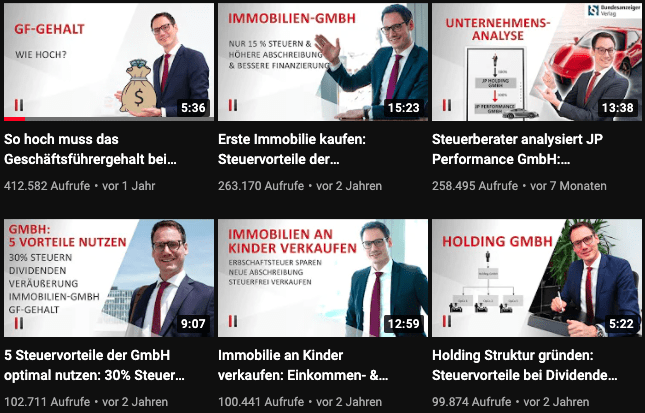
Taxes, and B2B on top of that? That is exactly what shows how powerful content marketing can be. Christoph Juhn regularly publishes videos on tax topics for business owners on YouTube, relaxed and serious at the same time. He also uses the videos as a podcast and on social media, and his website carries in-depth articles on tax questions. Anyone googling such topics often ends up with him. We also talked about the idea behind his strategy on the B2B! podcast (German).
Example 2: Liebscher & Bracht
Petra Bracht and Roland Liebscher-Bracht consistently give away their exercises against pain on YouTube and invite viewers to a newsletter with their best exercises. Behind it are products, an app and a therapist network. Not a B2B case, but a textbook example of content, lead magnet and offer working together.
Example 3: Copywriter Stephan Park
Stephan Park, who calls himself "Der Quotenchinese aus Österreich", shows as a solo freelancer that one platform is enough: with pointed LinkedIn posts he wins client enquiries for his copywriting.
Example 4: Talentmagnet Performance Recruiting
For our recruiting platform Talentmagnet I focused on two channels from 2019 onwards: in-depth articles and podcast episodes on performance recruiting. Over time this regularly brought enquiries from companies who already knew us and the offer before they first spoke to us. Selling then was almost order-taking. The difference from pure ads: content keeps working even when you are not spending budget.
Example 5: Pregfit
At Pregfit, the online fitness studio for pregnant women, founder Piet and I launched a clear content strategy in 2020: SEO-optimised blog articles on pregnancy and one YouTube video every week. From the articles, readers could download an e-book and so joined the email list. The offer for the main product followed there later. On a small scale, that is exactly the chain of expert content, lead magnet and list.
What all five have in common: they help first, they are regularly visible, they use one piece of content on several channels, and there is a clear next step for anyone who wants more.
Content marketing strategy in 5 steps
The biggest challenge in content marketing is rarely creativity. It is time. How do you stay visible on the important channels without producing something new every day?
That is exactly what a performance content system is for. The goal: create once, publish every day. Our system follows five steps we call the SKAVE formula (from the German initials): strategy, channels, recording, publishing, success.
Step 1: Strategy
Answer these questions up front and write the answers down:
- What for are you making content? What should it achieve, for example leads for a specific offer?
- Who is your ideal audience? As precisely as possible: role, industry, company size, region.
- Do you want to reach a small group with highly specialised topics or a larger one with broader topics? In B2B, specialisation almost always wins.
- What are competitors doing, and what do you do better?
- Who is the protagonist, the face in front of camera and microphone, and who is the editor who produces and publishes in the background?
In B2B, personal profiles perform much better than company pages.
Step 2: Channels
Your system consists of two types of channel:
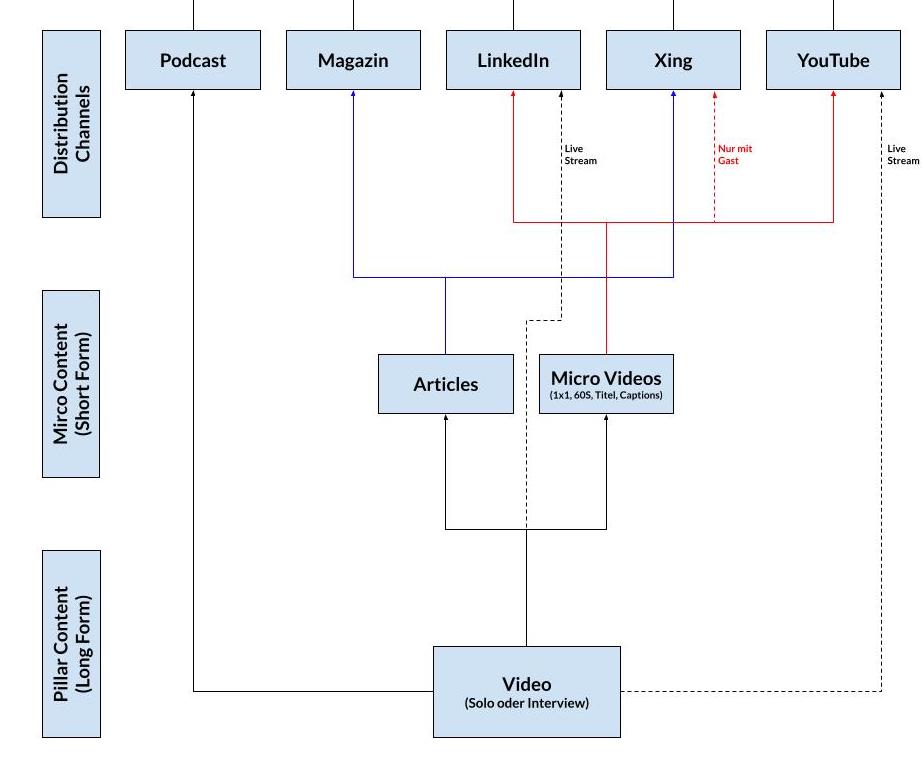
- A single pillar content channel. This is where your large piece appears, for example a YouTube video, a podcast episode or an article.
- One or two micro content channels. This is where the small pieces appear, for example LinkedIn posts and short videos.
At XHAUER it looks like this: one longer video becomes an article for the magazine, several short videos and posts for LinkedIn, plus the audio track for the B2B! podcast.
Two practical tips: choose as your pillar channel the one your protagonist feels most comfortable in and uses personally. And start lean with one or two micro channels. Master one platform first, then the next. In B2B that is almost always LinkedIn: LinkedIn is to B2B what Instagram is to B2C.
Step 3: Recording
Production needs a fixed routine:
- A content calendar with topics and publication dates.
- A recording spot with camera and microphone where you can start at the push of a button.
- A recurring slot in the calendar, blocked and high priority.
- A content checklist so every episode follows the same pattern.
- A recurring task in your task tool (Asana, Trello, ClickUp, Teams) with all templates.
Recording gets even easier with the interview method described below. Then one hour a month is enough.
Step 4: Publishing
Now the pillar content turns into micro content pieces. Create a task for each step and assign it to a person: editing, copywriting, graphics, scheduling, publishing. In the content calendar you spread all pieces across the week and channels.
Consistency beats intensity. One or two very good posts a week that you keep up for months achieve more than a daily sprint that stops after three weeks.
Step 5: Measure success and improve
After a few weeks the system settles in. Now ask the right questions:
- Did we choose the right channels, or should we focus on fewer?
- Which topics and formats bring engagement from the target audience, not just views?
- Which posts bring leads, meaning downloads and enquiries?
- Which steps can we hand off?
- Which content do we back with a lead magnet and ad budget?
Our principle: do more of what works. Every post is a data point. What works gets amplified, for example as a Thought Leader Ad.
Finding content ideas: rain, sunshine and 67 ideas
"I'm out of ideas" is the sentence we hear most often in workshops. Yet the best ideas are in your everyday work. You only have to collect and sort them.
The rain and sunshine principle
Your audience lives between two situations:
- Rain: the pain, the problem, the trigger symptom they feel in their working day. Guiding question: what really keeps them awake at night? Describe it in their industry jargon.
- Sunshine: the target state. How does their boss measure success? What does a good day look like once the problem is solved?
Good content meets people in the rain and shows the way into the sunshine. This is where the presumption of competence works: if you describe their rain better than they can, they think "this person gets exactly what I'm dealing with" and trust you with the solution too.
The 67 content ideas in three categories
Our list of 67 content ideas is sorted into three categories. A few guiding questions from it:
- Stance and positioning: Which uncomfortable truth does your industry know but not say out loud? Where do you disagree with the crowd? What would you write on a billboard that everyone in your audience sees for exactly one minute?
- From the engine room: Which objections do you hear in sales, and how do you answer them? Which false beliefs does your audience hold? Which red flags do you see in clients? Which success can others copy?
- Audience psychology, rain and sunshine: pains, goals, industry myths and typical mistakes.
Add an idea silo: a note in your phone app where you drop every idea in one or two keywords the moment it appears. An objection in a client meeting, a question at a trade fair, a mistake that annoys you. These are your rough diamonds.
9 title templates by funnel stage
Depending on the stage, you address a different awareness level. These templates work as post hooks, video titles, ads or article headlines.
Top of funnel: attention and problem awareness (rain)
- The 3 real reasons why [audience] keep [symptom]
- [Audience]? Do these 3 simple things against [symptom]
- How [target clients] say goodbye to [pain] once and for all
Here you call out the audience precisely and work with the symptom they actually feel. Relevance creates resonance.
Middle of funnel: solution and provider awareness (the way into the sunshine)
- [Topic] is changing [industry] right now: what you should do
- Most [target clients] believe [target state] is impossible. The proof that it isn't
- What we have learned in [X] years about how [target clients] reach [target state]
Now you work more with the target state and show that solutions exist and that you know them.
Bottom of funnel: purchase interest (sunshine)
- The new way [target clients] reach [target state]
- How this new [method] for [target state] changes everything
- How [reference client] reached [target state] in [time]
At this stage it is about your method and real client examples. Linking time and result ("in 6 months") makes case studies tangible. Use it only with real, approved cases.
Don't create, document: the documentational interview method
Sound familiar? 9 p.m., an empty document, the cursor blinking at you mockingly, and a post is due tomorrow.
The problem is inventing. The better way is: don't create, document. The phrase comes from Gary Vaynerchuk: document what happens in your working day anyway.
An example:
- Created: "The 3 most important rules in project management." Yawn.
- Documented: "Last week a client called me in a panic. The project was about to be cancelled because department A hadn't talked to department B. Here are the 3 steps we used to solve it in a crisis meeting on Friday …"
The expert value is the same, the packaging is real. And generic AI content cannot supply real cases from practice.
How the interview method works
The documentational interview method is our process for turning one hour of conversation into a month of content:
- Find a writing partner. An employee, a freelancer or an agency that draws out your knowledge and invents nothing.
- One video call a month, 60 minutes. Fixed in the calendar.
- Interview without preparation. The writing partner asks along the 67 ideas, for example: "What crazy objection did you get in a sales call last week?"
- Record, transcribe, shape. The transcript becomes posts following the Story-Teach-Tool template.
The result: material for the whole month, ideally two posts a week, so roughly eight posts from one hour. And they sound like your real words, because they are your words.
If you want it even faster: record a voice memo of a few minutes, have it transcribed and give it to an AI with the clear instruction to format your thoughts exactly according to the template. The AI should invent nothing, only give it shape. That is exactly how our AI content assistant XHANA works: you send a voice message via WhatsApp, and it becomes a thought leader post for your LinkedIn profile.
The ideal LinkedIn post: the Story-Teach-Tool template
What does the ideal B2B LinkedIn post look like? Our answer is a template we use for posts, emails, video scripts and articles. It has four parts: Hook, Story, Teach, Tool.
0. Hook. One sentence that compels a click on "see more". Examples:
- "Here is a concept that will massively improve your ability around [topic]."
- "There are 3 mistakes [audience] keep making when trying to reach [goal]. Here is the fix."
- "Something has happened: [event]. What it means for you now:"
1. Story. One to three, at most five punchy sentences, straight into the action. "I had just put the phone down when my colleague came running into the office …" or "This regularly drives me almost crazy: [problem]."
2. Teach. Three to five valuable tips as a list. Odd numbers read well. Tone matters: not lecturing, but "This works particularly well for us and many of our clients. I hope it's useful for you."
3. Tool. A tool for putting it into practice: checklist, template, PDF or video. No loud call to buy the main offer. Being able to do it beats knowing about it.
The 80/20 rule and your stance
For the mix: roughly 80 percent expert content, 20 percent personal storytelling. People love a look behind the scenes. And they can hold on to rough edges. Trying to please everyone on LinkedIn does not build a real personal brand.
Don't let perfectionism slow you down. If your ideas suddenly feel flat while writing, that is normal. Quantity leads to quality, and the commitment to publishing regularly matters more than the perfect single post.
More templates and the whole system: Download the LinkedIn Pipeline Playbook for free (German)
Posts that bring leads: comment for asset
Why do so many LinkedIn posts bring no leads? Usually one of three building blocks is missing: a post that truly builds trust, visibility with exactly the right audience, and a way to turn silent readers into leads.
The lead magnet: snackable instead of a white paper
Forget the 30-page industry report the team spends six weeks on and nobody downloads. Short, instantly usable tools for your audience's main bottleneck work better: a checklist, a self-assessment, a template, a step-by-step playbook.
Even the name makes a difference. A client in the CMS software space renamed their white paper a "7-step checklist". In one week it brought more leads than in the previous six months.
The "comment for asset" mechanic
This is how you connect post and lead magnet on LinkedIn:
- Write a post using Story-Teach-Tool on the topic of your lead magnet.
- Put no external link in the post, because the algorithm tends to slow down links that lead off the platform.
- End with the call: "Just comment 'template' and I'll send you the link by direct message."
- Send every commenter the link personally.
This works twice over. Comments are a strong relevance signal, and they appear in the commenters' networks. So the post reaches people in the second and third degree. With one post offering a free AI agent as a lead magnet, we got almost 1,800 comments and more than 500 leads from B2B marketing decision-makers in 9 days.
From post to pipeline
A good post alone is still not enough. Predictable leads need the whole chain:
- Amplify visibility: if a post works organically, run it as a Thought Leader Ad with a small budget in exactly your audience. Good posts then keep working for you instead of vanishing after two days.
- Retargeting: anyone who read your posts or watched your videos lands in an audience you can later target with your lead magnet.
- Nurturing: leads from the lead magnet are green bananas. They ripen in your email list until they say themselves: "Let's talk."
How this chain leads to a booked meeting in practice is described in detail in How to get new B2B clients.
Copywriting: 7 tips for text people actually read
Good content often fails because of language. We give our clients these seven copywriting tips again and again. They apply to posts, ads, emails and landing pages.
1. Only ever sell the next step
Every element has exactly one job. The image stops the scroll. The hook sells the second sentence. Every sentence sells the next. A button reads better as "Go to order form" than "Buy now". And in a campaign, never jump from problem awareness straight to provider awareness. Asking people to buy at the top of the funnel loses them.
2. The blank line is your friend
Nobody wants to read a wall of text, least of all on a smartphone. Keep paragraphs to three lines at most on desktop. Use labelling: short lines like "In short:", "For example:" or "Important:", each with a blank line before and after.
3. The magic words "so that"
Giving a reason wins. With "so that" plus a benefit you give every request a reason: "Enter your email address here so that we can send you the playbook."
4. Small full stop, big effect
Write short main clauses. Few subordinate clauses, no nested sentences, no hedging. What is easy to read gets read.
5. Personal pain hits home
Describe your target clients' problem personally and concretely, with your own experience and real words. Empty phrases trigger nothing. Personal closeness creates trust.
6. First- and second-order consequences
Ask "and what does that bring?" twice for every statement. "Take your marketing to the next level" first becomes "a steady flow of matching leads at a good price" and then "leads in the pipeline every day that sales can work with immediately".
7. The long-short-cream method
Three moves for strong core messages, for example on a website. An example from a workshop with a client offering recruiting for pharma and biotech. Starting text: "The candidate turbo – your vacancy filled with precision in pharma and biotech." Too sensational for an audience of decision-makers.
- Long: write the content down soberly and in full, with the consequences from tip 6. "Find and hire the right candidates quickly and easily in pharma and biotech."
- Short: cut it to the essence and add a comparison to the current situation. "Find the right candidates faster in pharma and biotech."
- Cream: one word as the cherry on top. "Find the right candidates faster in pharma and biotech. Precisely."
Everyone immediately understands whom the client helps and how, without it sounding like a market crier.
More formats: SEO articles, newsletters, short videos, VSL
In B2B, LinkedIn is usually the most important micro content channel. For pillar content and the path from interest to meeting, other formats come into play.
SEO articles: the niche strategy for Google
Organic search traffic has one big advantage: visitors are already searching for exactly your topic. And unlike ads, you do not pay for every visit. Our niche article strategy has three steps.
Step 1: Choose the right niche search term. Open Google search in an incognito window and type your topic in variations. The suggestions show what people really search for. Choose a long-tail term, so "content marketing examples" rather than just "content marketing". It demonstrably has search volume and less competition. Better to rank at the very top for a niche term than on page 2 for a big one. And importantly: one search term per article. For every further term, write a separate article.
Step 2: Write a helpful expert article. The best content for the search intent wins. Answer readers' questions fully, with tips and examples that are not found on every corner. Copy nothing. List articles like "5 tips for …" work well with readers. AI can help with structure and questions; the practical part you have to supply yourself.
Step 3: SEO optimisation. Work the search term naturally into title, meta description, subheadings and body, ideally at the very start of the title with a colon ("[search term]: 5 tips for …"). Short sections with H2 headings, embedded images, videos and podcast episodes, sensible internal and external links. Technically the page should load fast and work well on mobile. Finally, submit the article for indexing via Google Search Console.
How quickly this works varies. Some of our articles ranked high after a short time, others take longer. According to Google, some changes take effect within hours, others only after months. There is no guarantee of position 1.
Today Google also shows an AI overview for many searches, and many buyers ask ChatGPT directly. According to Google, no additional requirements apply for this; the SEO fundamentals remain relevant. What also helps: a clear author profile, visible dates and sections that answer one question on their own, around 150 to 400 words long. This article is built exactly that way.
Newsletter: a sales asset you own
A newsletter is where green bananas ripen. At XHAUER we deliver expert content week after week, practical, in the audience's language and with a personal touch. When readers get in touch, they say things like: "I feel like I already know you."
The second reason for a newsletter: it belongs to you. Don't build your house on rented land, on platforms whose rules and reach can change at any time. Your own list is the true company asset. How a thought leader newsletter brings leads even with long sales cycles is what I discuss with Tim Gelhausen in the video below (German).
Short videos: one shooting day a month
Short videos don't have to be expensive. With video pro Christian Arns I discussed how to produce short videos consistently with a smartphone and one shooting day a month, while testing different hooks. Raw videos often feel more genuine than glossy ones.
Video sales letter (VSL)
A video sales letter is a sales video on a landing page that leads cold traffic from ads from problem to solution to offer. It follows the same psychology as a good post. Using XHANA as an example, I took a VSL apart piece by piece (video below, German).
Your roadmap in 8 steps
If you want to start tomorrow, do this:
- Define audience and purpose: whom do you want to help, and which offer should the content ultimately support?
- Write down rain and sunshine: ten pains and ten goals of your audience in their language.
- Set up an idea silo: a notes app on your phone, from today every idea in two keywords.
- Choose a pillar channel: video, podcast, interview or article. Plus one or two micro channels, usually LinkedIn.
- Block an interview slot: 60 minutes a month with a writing partner, resulting in about eight posts.
- Write posts using Story-Teach-Tool: one or two a week, consistently.
- Build a lead magnet: a snackable checklist for the main bottleneck, distributed via "comment for asset".
- Measure and amplify: what works gets budget as a Thought Leader Ad. Leads move into the newsletter.
You'll find all eight steps with templates in the LinkedIn Pipeline Playbook (German).
Video and podcast on the topic
How performance content fills the B2B sales pipeline today:
How "performance content" fills the B2B sales pipeline (German)
B2B! Podcast: How "performance content" fills the B2B sales pipeline (German)
The ideal LinkedIn post with Hook, Story, Teach and Tool:
The ideal LinkedIn post: content, format, timing (German)
Why LinkedIn posts bring no leads and how to change that:
Why your LinkedIn posts bring no leads and how to change that (German)
How a company newsletter brings leads, with Tim Gelhausen:
How your company newsletter brings leads, with Tim Gelhausen (German)
Recording short videos quickly and easily, with Christian Arns:
Recording short videos quickly and easily: Reels, Shorts, TikToks (German)
A video sales letter taken apart piece by piece:
Video sales letter (VSL) example using XHANA (German)
The SEO niche strategy for Google:
Rank at the top of Google fast: the SEO niche strategy (German)
Conclusion: content as a system, not a gamble
B2B content marketing works when it runs as a system. A clear audience, one pillar piece a week or month, many small pieces from it, a fixed rhythm and a next step attached to every good piece.
You find the ideas in your everyday work, in your clients' rain and sunshine. Production becomes easy when you document instead of inventing, for example with one hour of interview a month. The post follows the template Hook, Story, Teach, Tool. And leads come when a post offers a real lead magnet and good posts are amplified with budget.
That is performance content: the impact of content marketing with the pace of performance marketing. Start small, keep going, and do more of what works. Whoever has the most stamina wins.
Your next step: Get The LinkedIn Pipeline Playbook (German) and implement the system step by step. If you lack time for writing, XHANA turns your voice message into a finished LinkedIn post. And if you'd rather build the whole chain with us, take a look at our LinkedIn agency.
About the author: Michael Asshauer is the founder of XHAUER, the LinkedIn agency for B2B. With his team he combines content and performance marketing so that companies build sales opportunities predictably via LinkedIn.