Short answer: LinkedIn Ads pay off in B2B when a new client is worth several thousand euros to you and you can describe your buyers by job title, industry and company size. Budget at least €50 a day for three months to run a real test. Start with Thought Leader Ads (promoted posts from real people), collect contacts with Lead Gen Forms, then reach the warm audience with retargeting and Message Ads. Company ads aimed at cold audiences are the most expensive route.
LinkedIn is the one ad platform where you can reach the managing directors of 200-to-500-person machine builders in a single region with real precision. That precision is priced in. Clicks cost more than on Meta or Google, and if you set up LinkedIn Ads like a Facebook campaign, your budget will be gone within weeks.
Over the past years my team and I have run LinkedIn campaigns for many B2B companies, from small consultancies to software vendors and industrial manufacturers. This guide is built from those campaigns: what LinkedIn advertising really costs, which formats are worth it, what ads that get clicked look like, and how to launch a campaign step by step. The biggest focus is on Thought Leader Ads, which in 2027 are the best starting point for most B2B companies.
You'll find the templates, checklists and example campaigns in The LinkedIn Pipeline Playbook (German).
Key terms
- Campaign Manager: LinkedIn's ad account, where you build campaigns, set budgets and read results.
- ICP (ideal customer profile): a precise description of your best-fit buyer, e.g. "Managing director, mechanical engineering, 50–500 employees, DACH".
- CPC, CPM, CPL: cost per click, cost per thousand impressions and cost per lead (a contact who signs up).
- CTR: click-through rate, the share of people who click after seeing an ad.
- Thought Leader Ad: a regular LinkedIn post by a person (a founder or an employee, say) that the company promotes as an ad.
- Lead Gen Form: a form inside LinkedIn, prefilled with profile data. The user never leaves the platform.
- Retargeting: ads aimed at people who have already engaged with your content.
- Insight Tag: a snippet on your website that records visitors for retargeting and conversion tracking.
1. Is LinkedIn advertising right for your business?
Check five prerequisites before you spend a cent. If one is missing, put the money somewhere else first.
Your audience can be described in LinkedIn terms
What LinkedIn really sells is targeting by profession: job title, function, seniority, industry, company size, company name, skills and location. If that's how you'd describe your clients, LinkedIn is strong. If your buyers are spread across every industry and role, it gets expensive and fuzzy. And some B2B audiences simply aren't active there. For one dental audience, LinkedIn leads were noticeably cold, while Meta delivered comparable contacts for less.
A client is worth enough
As a rule of thumb, the lifetime value of a client should be at least €8,000–10,000. In our experience a new client often takes €1,000–4,000 in ad spend. For a €200 product that doesn't work. For €50,000–100,000 deals it works very well.
You can fund a real test
LinkedIn lets you start at €10 a day, but that teaches you nothing. Plan at least €50 per day per campaign, ideally more, for at least three months. An older rule of thumb from our campaigns: audience size in thousands × €10 gives a sensible daily budget, so 30,000 people would mean €300 a day. Treat that as a ceiling for fast results, not a requirement to start.
Your company page is in shape
Ads run from a LinkedIn company page. It should be maintained and already have a base of at least 300 followers, ideally 1,000. Use the monthly invitation credits to invite your contacts to follow the page before you advertise. Nobody likes clicking an ad from an empty page.
Your offer fits the market
LinkedIn Ads amplify what already works. If nobody has bought your offer yet, ads won't find product-market fit for you. Test your message organically first: which posts get reactions from people in your target audience? Those are the topics you'll promote later.
2. How much do LinkedIn Ads cost in 2027?
It depends on who you want to reach and how good your ads are. To help you plan anyway, here's how pricing works and the ranges we see.
How the auction works
LinkedIn auctions every ad slot. You compete with other advertisers who want to reach the same person. If you win, you don't pay your full bid but one cent above the next-highest bid. Three things set your price:
- The audience. Managing directors and IT decision-makers are in high demand, so they cost more.
- The campaign objective and bidding strategy. A "Leads" objective prices differently from "Brand awareness".
- Ad relevance. LinkedIn rewards ads that get clicked. A strong CTR cuts your cost per click significantly.
The third factor is the one you control. On LinkedIn, good creative isn't decoration. It's how you lower costs.
Benchmarks for clicks, impressions and leads
| Metric | Typical range | Note |
|---|---|---|
| CPC | approx. €5–7 | well-optimized campaigns often well below that |
| CPM | approx. €30–60 | €50–100 for Thought Leader Ads |
| CPL with Lead Gen Forms | €20–120, around €60 on average across our clients | |
| Average CPL in Germany according to LinkedIn | approx. €124 | source: LinkedIn benchmark report, check year |
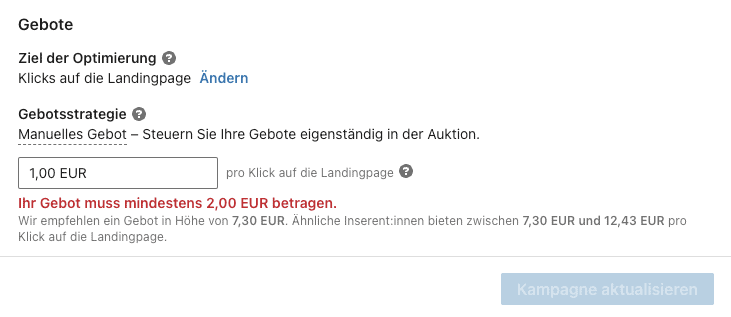
Campaign Manager suggests a bid range for your audience. In one example campaign it suggested €7.30 to €12.43 per click, with a €2 minimum. Treat that as a starting point, not a rule.
CPC or CPM?
Start by paying per click. You only pay when someone responds, and you learn which ads work. Once an ad holds a CTR above 1 %, check whether paying per thousand impressions works out cheaper. With a strong ad it usually does.
In our analyses, advertisers using manual bids sometimes paid up to 45 % more than necessary. Start with automated bidding or a cost cap, and only intervene once you have data.
Five ways to lower your costs
- Keep audiences between 20,000 and 80,000 people. Smaller gets expensive; larger gets unfocused.
- Test organically, then promote. What works as a regular post usually works as an ad.
- Use Thought Leader Ads instead of company ads (see section 4).
- Retarget. Warm contacts click more and buy more.
- Pick the objective deliberately. The engagement objective has a lower price floor, but it only pays if a large share of interactions are clicks rather than likes and comments.
3. LinkedIn ad formats at a glance
LinkedIn offers more formats than you need. Here are the ones that matter, with our take for B2B.
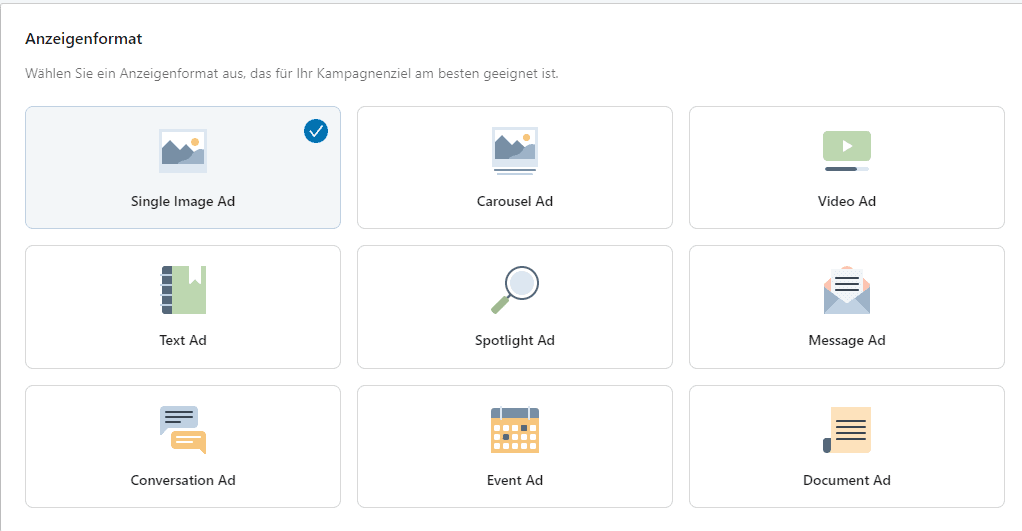
| Format | Use | Our take |
|---|---|---|
| Thought Leader Ad | promote posts by people | first choice for reach and trust |
| Single image ad | classic company ad | solid for lead campaigns with strong creative |
| Video ad | explain, build trust | good for retargeting audiences |
| Carousel | show several points or steps | good for how-tos and checklists |
| Document Ad | PDF readable in the feed | strong for lead generation |
| Event ad | webinars and live events | fast route to first conversations |
| Lead Gen Form | form inside LinkedIn | combines with almost every format |
| Text Ad | small sidebar ad (desktop) | very cheap reach |
| Message/Conversation Ad | message to the inbox | warm audiences only |
| Spotlight/Follower Ad | personalized sidebar ads | niche format |
Specs worth knowing
- Single image: square works best (1:1, e.g. 1080 × 1080 px). Headline up to about 70 characters; roughly the first 150 characters of intro text show before "see more".
- Video: always add captions, because most people watch on mute. Square or vertical beats 16:9 in the feed.
- Carousel: 2 to 10 cards, 1080 × 1080 px.
- Document Ad: PDF or slide deck, ideally under 10 pages. You can require the form after a few preview pages.
- Lead Gen Form: headline up to about 60 characters, 3 to 12 fields, privacy policy link required.
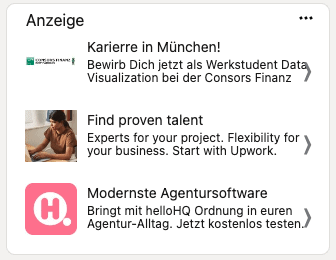
- Text Ad: headline about 25 characters, body about 75 characters, 100 × 100 px image.
- Message Ads: in the EU they can only be delivered to members who have opted in, which limits reach.
LinkedIn changes specs and character limits regularly, so check the current requirements in Campaign Manager before uploading.
4. Thought Leader Ads: the best place to start
If you implement only one section of this guide, make it this one.
What Thought Leader Ads are
Thought Leader Ads let you promote an ordinary post by a person: the CEO, a sales lead, an expert on the team, or an external creator who has agreed. In the feed it looks like a normal post by that person, with a small "Promoted" label.
That's a big difference from a company ad. People follow people. A post with a face, a personal opinion and real experience gets read. A logo with a slogan gets scrolled past.
What the numbers show
In our campaigns, Thought Leader Ads reach click-through rates far above classic ads, often 10–20 % instead of around 1 %. Cost per click has often been 20–30 cents instead of €5–7. CPMs tend to be higher (€50–100) because LinkedIn prices reach on personal posts differently. Net, you get far more real attention for your money.
The €80 machine
A model we like to start with: around €80 a day on Thought Leader Ads. With a clean audience that reaches about 1,000 people from your ICP every day. Over a month, tens of thousands of decision-makers see your name and your thinking without a single cold call. An organic post lives for about 24 to 48 hours; a promoted one stays visible for weeks, to exactly the people you want.
How to start
- Post organically first. Publish at least five posts on topics your audience cares about, and see which ones get reactions from ideal customers. Five reactions from real decision-makers beat 500 likes from peers.
- Promote the best posts. In Campaign Manager, choose "Browse existing content" to promote posts from team members who have given permission.
- Let it compound. Promote two posts in week one, four in week two, six in week three. Running posts stay live while new ones join, so your presence grows every week.
- Do more of what works. Switch off posts with weak CTR and move budget to the winners.
- Be patient. You'll see the numbers move within a few weeks. In our experience, first inquiries often arrive after three to six months.
Why it takes that long
Nobody in B2B buys after one ad. Decision-makers see you ten, twenty, thirty times. They remember your name, read a post in full, maybe comment once. Psychologists call this the mere-exposure effect: what we see often feels more familiar and credible. When the need arises, yours is the name that comes to mind.
A client in plant engineering showed this path clearly. Organic metrics were good for nine months; then Thought Leader Ads were added. After that, one or two qualified inquiries came in every week. After about 15 months he declined further budget because capacity could only grow with a new production hall.
How to write posts that work as Thought Leader Ads, and which topics have proven themselves, is covered in The LinkedIn Pipeline Playbook (German).
5. Lead Gen Forms and Document Ads: capturing contacts
Thought Leader Ads build awareness and trust. For a pipeline you also need names and email addresses. That's what Lead Gen Forms are for.
Why Lead Gen Forms work so well
The user clicks your ad and a form opens inside LinkedIn, with name, email, company and title prefilled from the profile. Two taps and done. No landing page, no load time, no typing on a phone.
What we've learned across many campaigns
We've run ad spend in the millions through Lead Gen Forms over the years. The main lessons:
- Few fields. First name, last name, email. That's it. Every extra field lowers completion.
- Don't ask for a phone number. It signals "a salesperson is about to call me".
- Capture the LinkedIn profile URL as a hidden field, so you can send a personal message later.
- A plain headline. "Free PDF: [topic]" beats clever wordplay.
- Short legal text. One sentence on how the data is used, plus a link to your privacy policy.
The lead magnet decides
The form is only as good as what you offer. A strong lead magnet is concrete, quick to use and solves a problem your audience has today. Checklists, short guides, playbooks, calculators and templates have all worked. One example: a calculator that lets IT managers estimate the effort of an ISO 27001 certification.
Packaging matters a lot. For a payroll services provider, the lead magnet was technically accurate but the title sounded like more work. We changed only the title and design; the topic stayed the same. Lead generation improved noticeably afterwards.
Our minimum checklist for a lead campaign: 3 creatives, 2 copy variants, 1 headline, at least €50 a day.
Document Ads: the PDF in the feed
With Document Ads, users page through a PDF right in the feed. You show the first pages for free and ask for the form to unlock the rest. In a test targeting CEOs and marketing leaders in the DACH region, we ran five cover pages against each other, and the cost per lead came in well below the market average. With Document Ads, the cover is your most important creative. Test it like an ad.
After the download: the follow-up message
A lead isn't a meeting yet. Send every new contact a short, personal LinkedIn message the same or next day. No pitch, just a friendly hello:
"Hi [name], thanks for downloading the PDF on [topic]! Feel free to reach out if you have any questions."
Many reply, and those conversations turn into meetings. How to nurture these contacts afterwards is covered in How to get new B2B clients.
Webinars as a shortcut
In our campaigns, the fastest route from ad to first call is often a webinar. Promote a live session with an event ad or a Lead Gen Form; attendees experience you as an expert for 45 minutes, and many book a call right afterwards. It also tests your topic: if nobody signs up, the message isn't landing.
6. Text Ads: the underrated reach hack
Text Ads are the small ads in the right-hand column on desktop. Most advertisers ignore them, which is exactly why they're cheap.
Our approach: we run Text Ads with the minimum CPC bid against a tight audience. Hardly anyone clicks, so we pay hardly anything, but the ad is still served. In one test this produced 711,000 impressions among managing directors, marketing heads and CMOs over 30 days for €96.71, a CPM of roughly 14 cents.
Clicks are beside the point. What counts is that your face and name keep showing up. So link the Text Ad to your personal LinkedIn profile rather than your website. Curious people check your profile, see your posts and may follow you.
7. Retargeting and Message Ads: harvesting warm contacts
Cold audiences are expensive. Warm audiences are where LinkedIn advertising turns a profit.
Build retargeting audiences
Set up audiences of people who have already engaged with you, from day one:
- people who engaged with your ads or posts in the last 90 days
- people who watched at least 50 % of your videos
- people who opened a Lead Gen Form but didn't submit it
- website visitors (via the Insight Tag)
- company page visitors
Short videos of 30 to 60 seconds are especially useful here. They're cheap to serve and fill your retargeting audiences quickly with people genuinely interested in the topic.
Your retargeting list works like a savings plan. You pay in every week, and after a few months you have a pool of warm contacts that keeps producing inquiries.
Message Ads: proposing at the right time
To a cold audience, an inbox message is like proposing on the first date. To a warm audience, it's the natural next step. That's why we run Message Ads exclusively against retargeting audiences.
A template that works:
"Hi [name], I noticed you've checked out some of our content on [topic]. We're running a short live webinar on it on Tuesday. Want to join?"
Unconventional subject lines help. With the subject "re: Tuesday" (in German, "wegen Dienstag") we measured open rates of 68–73 % on livestream invitations, with CTRs of 7–20 % and more. Meetings in those campaigns sometimes cost as little as €6–10 each.
Another example: a catering company offered warm contacts a "free lunch for your team" via Message Ad. A concrete, tangible offer instead of "let's talk".
Remember the EU restriction: Message Ads only reach members who have opted in, so expect smaller numbers than with feed ads.
8. LinkedIn ad examples: creatives and copy that work
You have about a second in the feed. In that second your image has to stand out and your first line has to spark curiosity. Glossy stock photos of smiling office workers won't do it.
Seven creative types that work in B2B
- Black-and-white meme. A familiar meme format applied to a problem only your audience knows, like a test-software vendor's meme about the ISO 26262 standard. If you don't know the standard, you won't get it. If you do, you feel spoken to immediately.
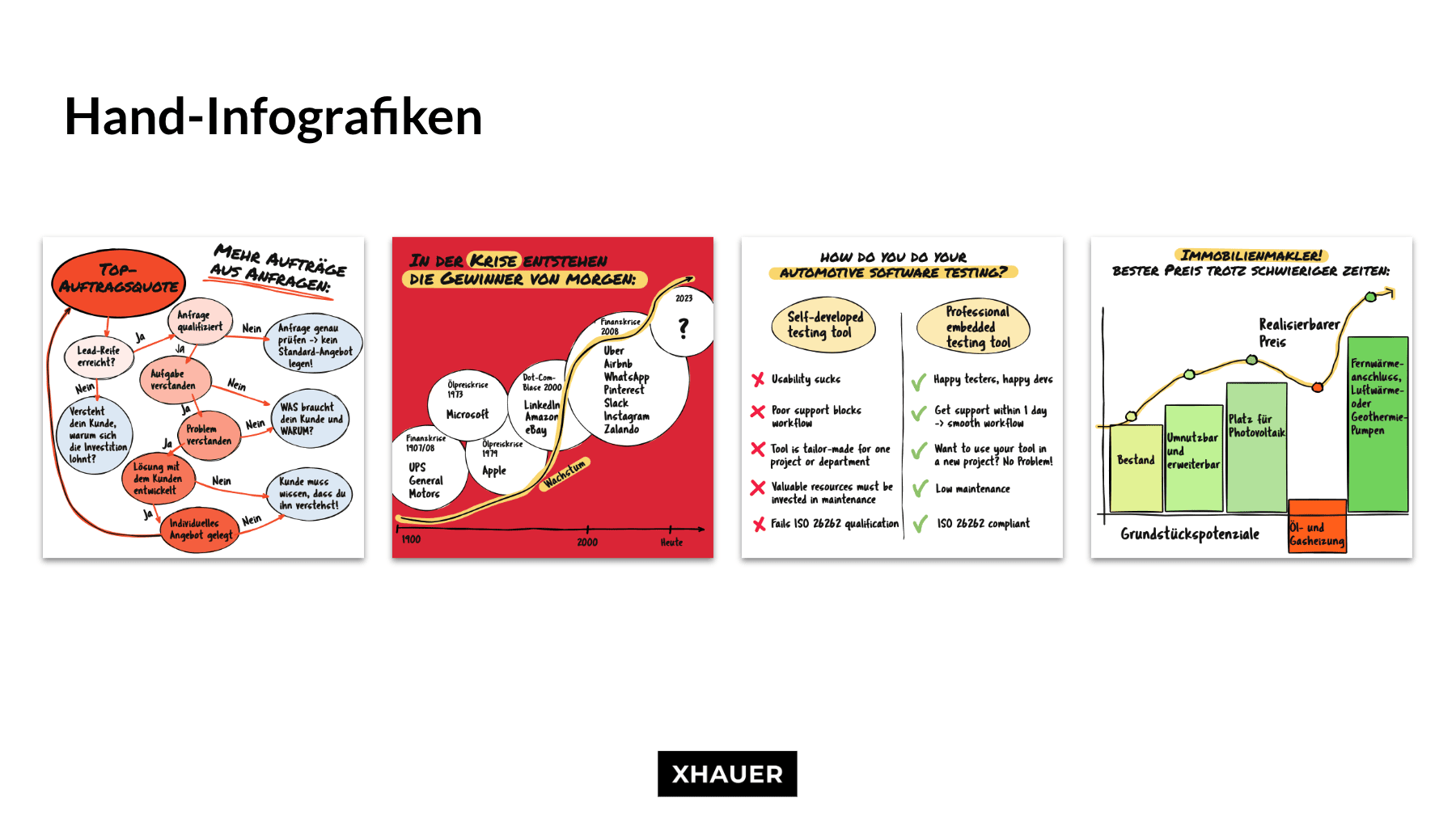
- Hand-drawn infographic. Looks like a whiteboard sketch, feels personal and gets read. One such graphic on a technical topic earned one of our clients more than 300 reactions.
- Comic. A short scene from your audience's working day, in three or four panels.
- Infographic plus comic. Facts with a character guiding you through them.
- Poster. Big type, few words, around nine at most. Like a billboard by the motorway.
- Chat look. An image styled as a chat thread, e.g. a client messaging a supplier.
- AI image. Can stand out, but be careful: in one example the image model invented a car model that doesn't exist. Experts spot errors like that instantly, and your credibility suffers.
A design rule that almost always helps: black and white with a single accent color. It makes your ad stand out among colorful posts.
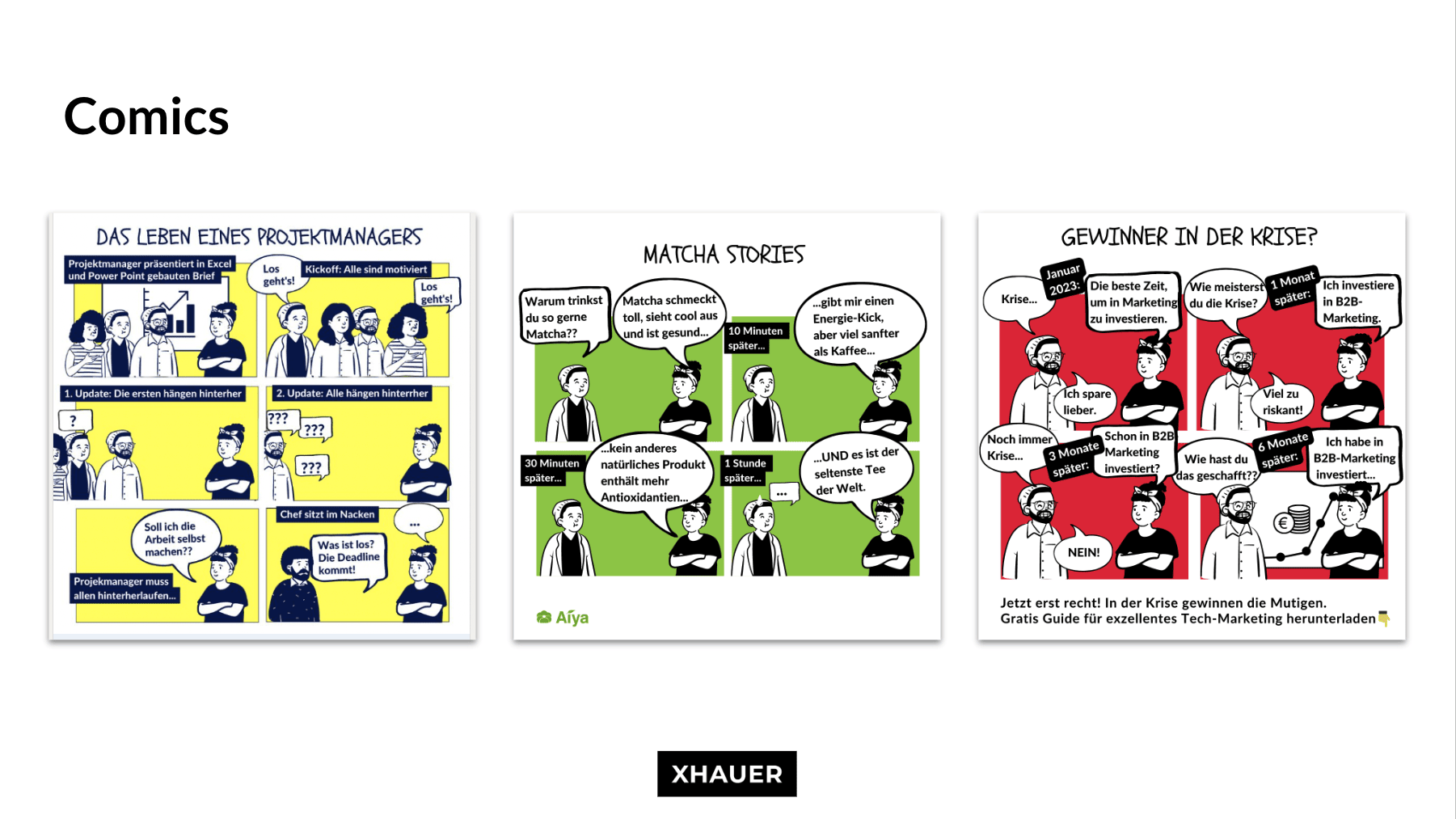
Copy that sounds like shop talk
The best test for your ad copy: does it sound like specialists talking shop at the pub after the third beer, or like a press release?
- Insider language in the first line. Terms only your audience knows filter automatically. "ISO 26262 qualification", or for a furniture supplier "finish foil, melamine board or CPL?": if you read it and understand it, it's for you.
- One concrete problem. Not "we optimize your processes", but the pain your client feels at 8 a.m.
- Something new. New regulations, deadlines, tools: news gets attention.
- A clear opener. "Fact is …" or a direct question works well.
- White space. Short paragraphs, blank lines, few emojis.
Cut words that say nothing: efficient, effective, sustainable, innovative, holistic, digitalization. Every competitor uses them, so nobody reads them.
More creative and copy templates are in The LinkedIn Pipeline Playbook (German).
9. How to run LinkedIn Ads, step by step
Step 1: Set up the account and Insight Tag
Create an ad account in Campaign Manager and link it to your company page. Install the Insight Tag on your website; without it you can neither track conversions nor retarget visitors. Define conversions such as "form submitted" or "meeting booked".
Step 2: Plan your campaign structure
LinkedIn offers three objective groups: awareness, consideration and conversions. Create one campaign per funnel stage, and don't mix cold and warm audiences in one campaign.
Use a consistent naming convention from day one, for example for campaigns:
`Format | Objective | Offer | Targeting | Audience size | Region`
and for ads:
`format-copy-headline-creative`
After three months and twenty campaigns, you'll be glad you did.
Step 3: Define your audience
- Start with roughly 50,000 to 100,000 people, then build focused audiences of 20,000 to 80,000.
- Combine attributes: job title or function plus seniority, industry, company size and location.
- Use Matched Audiences: contact lists, company lists (account-based marketing) and website visitors.
- Turn off Audience Expansion. Otherwise LinkedIn serves your ad to "similar" people who often don't fit.
- If your audience works internationally, include English as a profile language. Many DACH decision-makers use LinkedIn in English and fall through the cracks otherwise.
- Create your retargeting audiences now. They take time to fill.
Step 4: Set budget and bid
Use a daily budget rather than a lifetime budget, and start with automated bidding or a cost cap. A quick check: if your daily budget is gone by midday, either the budget is too low or the bid too high.
Step 5: Create the ads
Create at least three to five ads per campaign with different creatives and copy. LinkedIn reviews new ads, which can take up to 24 hours.
Step 6: Connect the Lead Gen Form
Build the form, attach it to the ad and sync leads to your CRM or email tool. Leads that sit in Campaign Manager for days go cold.
Step 7: Launch and leave it alone for two weeks
Changes take effect at midnight UTC, and results only become meaningful after several days. Give every campaign two weeks before big decisions.
10. Optimizing campaigns: why ads fail
The first days
The learning phase lasts one to two days. After that, pause ads with clearly weaker CTR, but always keep at least five ads in rotation so LinkedIn has enough to work with.
Ad fatigue
After about 30 days, CTR drops because your audience has seen the ad. Change the copy first, then the image, so you can see which change made the difference.
Three common problems and fixes
| Problem | Cause | Fix |
|---|---|---|
| Low CTR | creative doesn't stand out or doesn't speak to the audience | new creative, insider language, pattern interrupt |
| High CPC | low relevance, audience too narrow or contested | improve CTR, widen audience, Thought Leader Ads |
| Low conversion rate | offer or form doesn't fit | rework lead magnet, fewer fields, clearer headline |
Before you crown a winner, the difference should be statistically sound; 95 % significance is a good benchmark. With small numbers, chance is often bigger than the effect.
The AMO principle
When a €50-a-day campaign doesn't work, in our experience it almost always comes down to one of three things:
- A for audience. Wrong, too broad or too small.
- M for message. It doesn't hit a real problem or sounds like advertising.
- O for offer. Not attractive enough, e.g. a "free consultation" for people who don't know you yet.
Check all three before raising the budget. More money doesn't fix a bad campaign; it just makes it more expensive. We know companies that sank €20,000 into LinkedIn Ads because they asked cold audiences for meetings right away.
Leads aren't clients
In one project, cost per lead was €150–300. That looks high. The value came afterwards, through consistent follow-up and nurturing. Judge LinkedIn Ads by conversations and deals, not by the price of a single lead.
Our minimum benchmarks
- Reach at least 1,000 people from your ICP per day.
- Give every ad at least 3,000 impressions before judging it.
- Watch for reactions from ideal customers. Five of those are worth more than any average.
11. Your 90-day roadmap
Weeks 1–2: Foundation
- clean up the company page, invite contacts
- set up the ad account and Insight Tag
- write down your ICP
- publish five organic posts on core topics
Weeks 3–4: Launch Thought Leader Ads
- promote your two or three best posts, about €50–80 a day
- create retargeting audiences
- run Text Ads at minimum bid against your audience
Month 2: Lead campaign
- create a lead magnet (checklist, guide or calculator)
- Lead Gen Form with three fields plus profile URL
- 3 creatives, 2 copy variants, 1 headline, at least €50 a day
- follow-up message to every new lead
Month 3: Harvest
- Message Ads to retargeting audiences, e.g. a webinar invitation
- pause weak ads, scale the winners
- evaluate by conversations and deals, not just clicks
Templates for every one of these steps are in The LinkedIn Pipeline Playbook (German).
Video and podcast
All of the following episodes are in German.
The five key points about LinkedIn Ads in brief (German):
The five key points about LinkedIn Ads in brief (German)
Formats, costs and examples at a glance (German):
Formats, costs and examples at a glance (German)
Seven ad examples from real B2B campaigns (German):
Seven ad examples from real B2B campaigns (German)
How we set up a Thought Leader Ads campaign (German):
How we set up a Thought Leader Ads campaign (German)
Why LinkedIn Ads fail (German):
Why LinkedIn Ads fail (German)
Document Ads put to the test, to watch or listen (German):
Document Ads put to the test (German)
Document Ads put to the test (Podcast) (German)
The Text Ads hack for cheap reach (German):
The Text Ads hack for cheap reach (German)
The Text Ads hack for cheap reach (Podcast) (German)
The fastest route from LinkedIn Ads to meetings (German):
The fastest route from LinkedIn Ads to meetings (German)
The fastest route from LinkedIn Ads to meetings (Podcast) (German)
Conclusion: LinkedIn Ads are something you build
LinkedIn Ads get expensive when you treat them like a tap: money in, leads out. They become profitable when you build them as a system:
- Thought Leader Ads make you known and trusted by your audience.
- Lead Gen Forms with a useful lead magnet collect contacts.
- Retargeting and Message Ads reach warm contacts at the right moment.
- Strong creative and copy lower your costs at every stage.
Plan for three months and a realistic budget, judge results by conversations rather than clicks, and scale what works.
If you'd rather not set it up alone: as a LinkedIn agency for B2B, we plan, run and optimize LinkedIn Ads for companies, from targeting and creatives to the follow-up sequence.
Your next step: Get The LinkedIn Pipeline Playbook (German) and build your first Thought Leader Ads campaign with our templates.
Michael Asshauer is the founder and managing director of XHAUER Media GmbH. With his team he builds predictable sales pipelines on LinkedIn for B2B companies, combining ads, content and personal outreach.