Short answer: Using LinkedIn well in B2B means three things. Your personal profile works like a landing page. You post expert content once or twice a week that describes your audience's problem better than they could themselves. And you make sure the right decision-makers see that content again and again. People buy from faces, not from company logos. That is why the personal brands of your leadership and specialists are the strongest lever, and the company page is the supporting act.
Most B2B companies have LinkedIn. Few of them actually use it.
The profile reads like a CV from 2010. The company page posts once a quarter: "We're attending this exhibition …". And when someone asks what LinkedIn brings in, the honest answer is: exactly zero inquiries.
Meanwhile, people in the same industry get stopped at every trade fair: "I know you from LinkedIn!"
The difference is not talent, and it is not a huge budget. It is a system. In this guide I have brought together what we at XHAUER have written, tested and implemented with clients over the past years: how to turn your profile into a landing page, why your banner can become a follower magnet, what the algorithm actually rewards, how a good post is built, and how a personal brand turns into real demand for your company.
The LinkedIn Pipeline Playbook: Want to go beyond reading and build your profile, posts and reach step by step? The playbook gives you the system behind this article in a compact, workable format. Download the LinkedIn Pipeline Playbook for free (German)
Key terms explained
Personal brand: The picture others have of you when you are not in the room. People say a company's brand is what gets said about it behind its back. The same goes for you. So you always have a personal brand. The only question is whether you shape it.
Thought leader: A person seen by their industry and audience as the go-to source for a subject. Thought leaders don't sell loudly. They share knowledge, take a stance, and so they get asked when a need arises.
Presumed competence: My core principle for content. If someone can describe a problem we have as well as we can, or even better, we automatically assume they also have the best solution.
Algorithm: The system LinkedIn uses to decide who sees which post in their feed. Among other things, it weighs content, dwell time and interactions.
Dwell time: How long someone stays on your post. Long dwell time tells LinkedIn the content is relevant.
Thought Leader Ads: Personal posts from your profile that a company promotes with ad budget to a defined audience. In the feed they look like normal posts, marked "Promoted".
Retargeting audience: People who have already engaged with your content, visited your profile or watched your videos. They know you, and you can address them again in a targeted way.
Social Selling Index (SSI): A LinkedIn score from 0 to 100 showing how actively and effectively you use the platform.
Why LinkedIn makes the difference in B2B
LinkedIn is the world's largest business network. According to LinkedIn, more than one billion people are registered, over 24 million of them in the German-speaking DACH region. For B2B that is unique: nowhere else can you reach decision-makers so precisely by role, industry and company size.
There is a second point. On LinkedIn you can still get visibility organically, without paying for every contact. On Facebook or Instagram, that era ended for companies long ago.
Even so, many B2B companies use LinkedIn mostly as a stalking tool. They look up applicants or meeting partners, post rarely, and when they do, it is a press release. One of our clients, a logistics provider, did exactly that before. The result, honestly: zero inbound inquiries via LinkedIn. Today prospects tell him: "Hey, I already know you from LinkedIn."
That shows what this is about. In complex B2B, such as IT, manufacturing, engineering or consulting, trust is the hardest currency. And trust grows when people see you again and again, before they even have a need. Every sale started with visibility.
How that visibility turns into concrete new clients is covered in detail in my guide How to get new B2B clients. This article is about the foundation: you and your team on LinkedIn.
Personal branding: why faces sell more than logos
In the end, people buy from people. From faces, not from anonymous company logos.
I admit I didn't always see it that way. At our earlier startup Familonet, it was my co-founder Hauke who took care of his personal brand. Today the XHAUER Magazin, the B2B! podcast and our YouTube channel are closely tied to my name. Over the years I have understood why that works.
What a personal brand does for founders and executives
- Sales gets easier. Conversations don't start from zero, because the other person already knows you.
- You attract better people. The best talent chooses their boss, not just the product or the company name.
- You stay top of mind when a need arises. Many B2B buyers don't google. They think of the person they have seen in their feed for months.
One of our clients sells a specialist product to the food industry. Demand there comes in cycles. When the time comes, nobody searches for suppliers. They say: "Ah, sure, I know him!" You can't buy that effect. You can only build it.
What a personal brand does for employees
Personal branding is not just for leadership. Specialists who are visible benefit too:
- your market value rises,
- you get the more interesting projects and offers more easily,
- you carry more weight inside and outside the company.
For companies this means every team member who is visible on LinkedIn is one more face for the brand. That is exactly why we call this section "LinkedIn skills for your team".
Positioning: what do you want to stand for?
Before you start, answer a few basic questions:
- What do I want my name to stand for?
- What is my core topic, and what am I genuinely good at?
- Who is my audience, and which problems can I solve for them?
- Which values do I hold, which references can I show?
A simple test is the five-person feedback method. Ask five people who know you well for a short one-to-one conversation and ask them: How do I come across? What is my strength? What could I do differently? One rule matters: you don't comment on the feedback, not even with your facial expression. You just listen.
Your profile as a landing page
Your LinkedIn profile is your most important landing page. Full stop.
Every post, every comment, every ad sends people to your profile. If they find a dusty, tabular CV there, the chance is gone. A visitor has to understand within about three seconds what you do and which problem you solve. The simple rule: remove friction, raise conversion.
The shop window has to shine before you send visitors to it.
Your headline is LinkedIn SEO
The headline under your name is the most important text field on LinkedIn. It appears everywhere: in search, next to comments, on connection requests.
Nobody searches for "Managing Director at Miller Ltd". Put in the terms your audience actually searches for. A colleague of ours added "podcast marketing" to her headline and moved up in LinkedIn search as a result. LinkedIn profiles also tend to rank high on Google when someone searches your name.
Run your headline through the "So what's in it for me?" test. Three mistakes show up right away:
- The ego trap: "Owner of XY Ltd". It says who you are, not what the reader gets.
- The cliché machine: "We deliver quality with passion." Everyone says that.
- The jack of all trades: "Consultant, speaker, investor, barbecue fan." Trying to be everything makes you nothing.
Better: who do you work for, which problem do you solve, and what is the result?

Checklist: setting up your LinkedIn profile
- Profile photo: friendly, current, face clearly visible (more below).
- Banner: use it as ad space, not as a placeholder (see next section).
- Headline: audience, problem, result, using your customers' search terms.
- Custom URL: linkedin.com/in/firstname-lastname instead of a string of numbers.
- About section: write in your audience's language. What is their problem, how do you help, what is the next step?
- "Follow" as the main action: if you post regularly, it pays for visitors to follow you rather than send a connection request. Check in your settings which option LinkedIn currently offers.
- Featured: your best posts, a video, an article and, ideally, a link to a useful download.
- Experience and media: work samples, projects and results instead of bare job titles.
- Recommendations: ask happy clients or colleagues for a short recommendation.
- Keep it current: a profile is never finished. Look at it with fresh eyes every few months.
The LinkedIn Pipeline Playbook (German) has these points as a tick-box checklist.
The banner hack: arrow, bell, followers
Your banner, the large background image at the top of your profile, is the most valuable digital billboard you get for free. Most people waste it: grey default pattern, a stock photo of a skyline, or a company logo in the middle.
Use the banner for a clear message and a call to action instead. An example from our team: "Daily B2B marketing tips? Click follow. Ring the bell."
Why the bell matters so much
Every profile has a small bell. Anyone who activates it gets a notification for each new post from you. With organic reach shrinking, that is a real lifeline: your most loyal readers see your posts, whatever the algorithm is doing.
The arrow trick
Here is how the hack works:
- Make the bottom quarter to third of the banner white. That visually merges the banner with the profile below it.
- Let an arrow reach from the coloured part into the white part.
- Point the arrow exactly at the bell or the follow button.
Check the result on desktop and mobile, because LinkedIn crops the banner differently depending on the device.
What follows is a small flywheel: more people activate the bell, catch your posts, engage early, their network sees those interactions, new people visit your profile and follow you too.
Presumed competence: what you should post
The question I hear most often: "What am I supposed to post?"
My answer starts with a principle I call presumed competence. If someone can describe a problem we have as well as we can, or even better, we automatically assume they also have the best solution.
So your goal is for someone in your audience to read your post and think: "Damn, he's speaking straight from my heart."
The fear of giving away too much
Many people hold back their knowledge so nobody uses it for free. Picture a restaurant handing out tasters without any seasoning. Nobody books a table afterwards. Content works the same way.
Knowledge is available everywhere today anyway. Clients don't buy knowledge from you. They buy certainty, speed and implementation. Give away the information and sell the implementation.
Rain and sunshine: topics that move your audience
For topics I like the image of rain and sunshine:
- Rain situations: What annoys your audience day to day? What keeps them up at night? Describe it in their words, in the industry's own jargon.
- Sunshine situations: What goals do they have? How does their boss measure success?
Add topics from the engine room, straight from the sales front line: Which objections do you hear all the time? Which false beliefs are common in the industry? Which typical mistakes do you see? And stance topics: which uncomfortable truth would you put on a billboard that your entire audience sees for exactly one minute?
The 80/20 rule and the idea silo
As a rule of thumb: around 80 percent expert content, 20 percent personal stories. Expertise shows competence; the personal side makes you tangible. People love a look behind the scenes. Rough edges give them something to hold on to.
Ideas don't come in brainstorming sessions. They come in everyday work. Set up an idea silo in your phone's notes app and jot down each idea in a word or two. When a client asks an interesting question, that is your post for Thursday.
The principle behind it: document, don't invent. Hardly anyone reads "The 3 most important rules of project management". Plenty of people read "Last week a client called me in a panic; the project was about to be cancelled. Here are the three steps we used to fix it by Friday." The expert content is the same; the packaging is real.
A good LinkedIn post: structure and craft
There is no perfect LinkedIn post. But there is a craft that makes your posts work much more often.
The story-teach-tool template
My standard template for posts, emails and video scripts:
- Hook: one sentence that forces a click on "see more". For example: "There are three mistakes [audience] keeps making when trying to reach [goal]."
- Story: one to three, at most five short sentences, straight into the action. "I'm just hanging up the phone when my colleague walks into the office …"
- Teach: three to five concrete tips, ideally as a list. No lecturing tone: "This works especially well for us and many of our clients."
- Tool: a useful tool at the end, such as a checklist or a template. Not a pushy pitch for your main offer.
Craft for every post
- Know your audience: industry, role, company size, questions and problems. Write for exactly these people.
- Scroll stopper: the first one or two lines decide. Break the feed pattern with a surprising statement, a question or a concrete scene.
- Emotion: good posts trigger at least one of the seven basic emotions: joy, sadness, surprise, anger, fear, disgust or contempt. In expert content this often means surprise at a new angle or frustration about a familiar problem.
- Structure and white space: short paragraphs, lists, maybe a few emojis as signposts. On a phone, the text has to breathe.
- Length: better a bit longer and substantial than too short. Dwell time is an important signal.
- A question at the end: invite opinions and experiences. Comments are the strongest signal.
- Images and videos: your own photos and natively uploaded videos instead of stock images or YouTube links.
- Language: write the way you speak. Casual language is fine.
Comment for a tool
One format that works especially well for us: you offer a template or checklist in the post and ask anyone interested to comment a keyword, for example "template". You then send the link by direct message. That way you avoid external links in the post, collect lots of comments and reach the commenters' networks. One of our own posts drew almost 1,800 comments and more than 500 leads in nine days this way.
What doesn't work
Pure sales posts with a buy-now call, mass tagging, posts that obviously aren't yours, and unedited AI text. An AI has no opinion and has never lost a night's sleep over a project. Use AI to format your own thoughts, for instance from a voice note. The substance has to come from you.
That is exactly why we built XHANA: you record your thoughts as a WhatsApp voice message, and it turns them into a LinkedIn post in your own words.
The LinkedIn algorithm: what really drives reach
There are plenty of myths about the LinkedIn algorithm. The good news: it is easier to understand than you might think. Just don't chase every single rule. The details change; the basic logic stays.
What changed recently
In March 2026, LinkedIn described on its engineering blog that the feed had been rebuilt technically and that an AI language model now understands the content of posts better. For you this means valuable expert posts that match a reader's interests can be shown well beyond your direct network. Since 2023, LinkedIn has favoured posts that share knowledge and advice, and it weighs expertise and substantial comments higher than shallow reactions.
The three basic secrets
- Content quality: after you publish, LinkedIn checks whether your post is good content or spam and estimates how well it will perform. Content with expertise, a real story and emotion does better.
- Interaction: your post is first shown to part of your network. If people stop, click "see more", stay a while and comment, it gets shown more widely. A good post passes these five steps: readers stop, click "see more", feel something, stay a while and engage.
- Format: our experience over the past years is that documents (slides), text with an image and polls usually get good distribution, plain text and video do solidly, articles hardly at all. But this fluctuates, and no format is a guarantee.
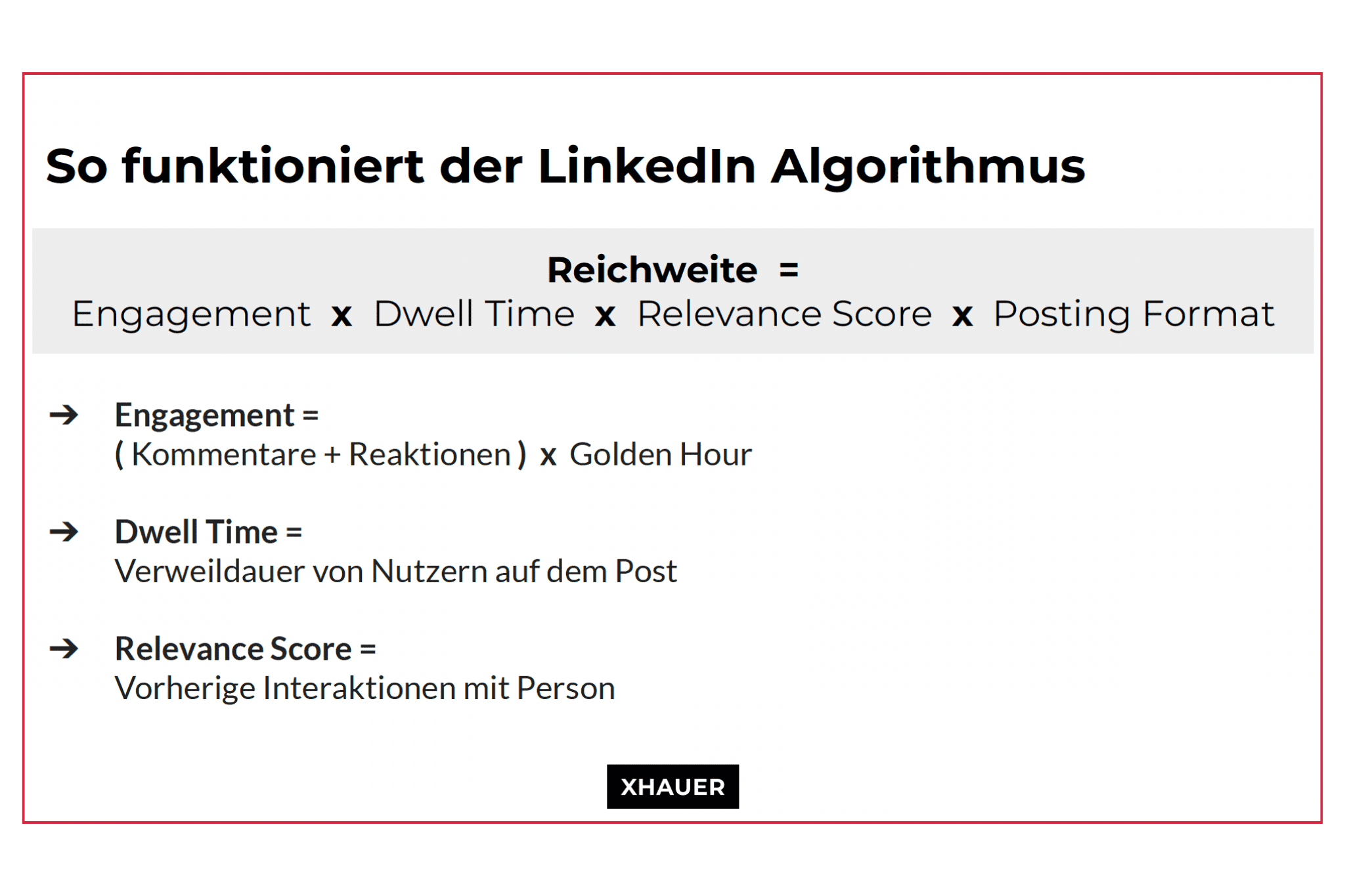
What studies say
Consultant Richard van der Blom publishes an annual Algorithm Insights Report. In the 2025 edition he describes, among other things, that many creators have lost reach, paid content is growing, comments count far more than likes, external links slow reach down, and company pages now make up only a very small share of the feed. Also: most users scroll on mobile, so posts have to work on a phone.
What the algorithm and users don't like
- External links in the post. LinkedIn wants to keep people on the platform. Put the link in a direct message or, if needed, in the first comment.
- External videos. Upload videos directly to LinkedIn.
- Pure sales posts with a hard call to buy.
- Mass tagging. Only tag people who genuinely have something to do with the content, a handful at most.
- Too many hashtags. They bring little reach. Three are more than enough.
- Post and ghost. If you post and then disappear, you give away reach. Reply to comments within the first hour and check back later.
More reach on LinkedIn: the measures that matter
Out of the 17+1 measures in our earlier article on reach, these have the biggest effect:
- Complete your profile. Without a good profile, any reach fizzles out.
- Grow your network deliberately. Connect regularly with people in your audience, for example three to five a day, with a short personal note. LinkedIn search helps, including combinations like "marketing AND engineering".
- Post regularly, quality over quantity. One or two very good posts a week beat daily mediocrity. Leave enough time between posts so they don't eat each other's reach.
- Be a problem solver. What problems and needs do your followers have, and how can you help?
- Vary formats: text, image, document, poll, video.
- Comment on other people's posts. Substantial comments under posts from your audience make you visible, often more than your own posts.
- Look after your own posts. Reply to comments, follow up on questions, keep discussions going.
- Invite interaction. Ask questions, ask for opinions, take a pointed stance now and then.
- Don't oversell. Constant advertising loses readers.
- Review your results. Look at which posts did well and do more of what works. The Social Selling Index also shows you where you stand.
Bonus measure: just start. Consistency beats intensity. Whoever sticks with it and has the longest time horizon wins.
An honest caveat belongs here too: in B2B, organic reach alone only takes you so far. More on that below.
The company page: use it well instead of posting in vain
Many marketing teams pour a lot of time into the company page. But organic reach for company pages is very low. People follow people, not logos. So posting there every day and hoping for reach achieves little.
You still shouldn't drop it entirely. It makes sense to:
- Keep it as a business card. Anyone who looks up your company after reading a post should find a complete, current page.
- Share personal content. Share good posts from your team on the company page using "Share directly".
- Use it as the sender of ads. This is where the company page shows its strength: as the sender of ads to people who already know members of your team. Then they think: "Ah, that's Michael's company."
In our video on the company page I show three more tricks you can put in place quickly (link in the "Video and podcast" section).
Personal branding photos without a studio
Your profile photo and the images in your posts are part of your personal brand. The perfect, polished business portrait often performs worse than a genuine photo from your working day.
Personal branding photographer Dani Gruber joined our XHAUER Circle to talk about this. Her message: you can take good photos for posts, ads and your website yourself, quickly, with a smartphone and no special gear. What matters is visual style, setting and perspective.
A few ground rules:
- Face clearly visible, natural light, a friendly look.
- Real situations: at your desk, in conversation, at a trade fair, in the workshop.
- Recognisability: a similar style, similar colours, maybe even a signature pose. One of our clients has a photo pose that other people now copy at trade fairs.
- Build a stock: take a few dozen photos in one go, and you have material for months.
From personal brand to thought leader: reach with a system
Organic posts have three drawbacks. They are seen by a few hundred to a few thousand people. Only a small share of those belong to your exact audience. And after 24 to 48 hours they have sunk into the depths of the feed.
5,000 or 10,000 views feel good. But if only a fraction of them are decision-makers in your audience, that is mostly good for the ego.
Step 1: two good posts a week
Start with your personal profile and two posts a week using the story-teach-tool template. That is all you need. Step 2 shows why.
If you lack the time: someone from your team or an agency interviews you once a month for about 60 minutes about objections, client questions and experiences. The recording becomes the month's posts, in your own words.
Step 2: Thought Leader Ads as a booster
With Thought Leader Ads you put budget behind your posts and show them to your audience, for instance decision-makers in a specific industry, region and company size. Then something interesting happens, a compounding effect: in week 1 two posts are working for you, in week 2 four, in week 3 six. Each post becomes a small digital sales rep working in the background around the clock.
Along the way you learn which messages really land. That helps you on your website, in emails and at trade fairs too.
Step 3: the harvest
Anyone who reads your posts, watches your videos or visits your profile ends up in a retargeting audience. Figuratively speaking, we're already pulling these fish into the net and onto the boat. These people know you and trust you to a degree. Now you can reach them with your company's ads, webinars and downloads. They respond far more openly because they already know you.
That is how a personal brand becomes a thought leader, and a thought leader becomes demand for the company. How this works in detail, with costs and formats, is covered in LinkedIn Ads for B2B. I describe the full path to the sales conversation in the guide How to get new B2B clients.
You will find all three steps with templates in the LinkedIn Pipeline Playbook (German).
Your roadmap in 8 steps
- Clarify your positioning: what do you want to stand for, for whom, with which problem? Get feedback from five people.
- Turn your profile into a landing page: headline with search terms, About section in your audience's language, custom URL, Featured with a useful download.
- Rebuild your banner: clear message, "Click follow, ring the bell", arrow pointing at the bell.
- Take photos: one afternoon with your phone, a few dozen real images.
- Set up an idea silo: collect rain and sunshine topics, objections and client questions.
- Two posts a week: story-teach-tool, a question at the end, no external links.
- 15 minutes of interaction a day: reply to comments, comment thoughtfully in your audience, connect deliberately.
- Scale your reach: promote posts that perform well organically with Thought Leader Ads to your exact audience, then harvest the retargeting audience.
All eight steps with checklists and templates are in the LinkedIn Pipeline Playbook (German).
Video and podcast
How to turn your profile into a landing page, shown live on real profiles in this profile check (German):
LinkedIn Profil-Check & Content-Strategie für Berater (Live) (German)
B2B! Podcast: LinkedIn Profil-Check & Content-Strategie für Management-Berater (Live) (German)
The four factors behind the algorithm and the formatting rules I give every client (German):
LinkedIn Reichweite aufbauen: So spielt der Algorithmus für dich! (2026 Update) (German)
B2B! Podcast: LinkedIn Reichweite aufbauen (2026 Update) (German)
What to do with your company page instead (German):
LinkedIn Unternehmensseite klug nutzen (3 Geheimtipps) (German)
Why faces instead of logos bring more demand (German):
Personenmarke aufbauen: Nachfrage durch Gesichter statt Logos (German)
Good personal branding photos with a smartphone, with Dani Gruber (German):
Gute Personal Branding Fotos schnell und einfach erstellen (German)
And how Thought Leader Ads keep your posts in front of your audience (German):
LinkedIn Thought Leader Guide 2026 (German)
Conclusion
Using LinkedIn well in B2B is not rocket science. You need a profile that makes clear in three seconds who you help. A banner that invites people to follow. One or two posts a week that describe your audience's problem better than they could. And, if you are serious, a system that keeps putting those posts in front of the right decision-makers.
Start with yourself, then bring your team in. Every additional face makes your company more tangible.
If you don't want to build this alone: as a LinkedIn agency for B2B, we implement exactly this system for companies, from profile optimisation and posts to Thought Leader Ads and retargeting. And if you lack time for writing, try XHANA.
Your next step: Get The LinkedIn Pipeline Playbook (German) and bring your profile up to landing-page level this week.
About the author: Michael Asshauer is the founder of XHAUER, the LinkedIn agency for B2B. With his team he builds personal brands and predictable pipelines on LinkedIn for companies.